|
|
|
CHAPTER 2: A Chilean Arrival...
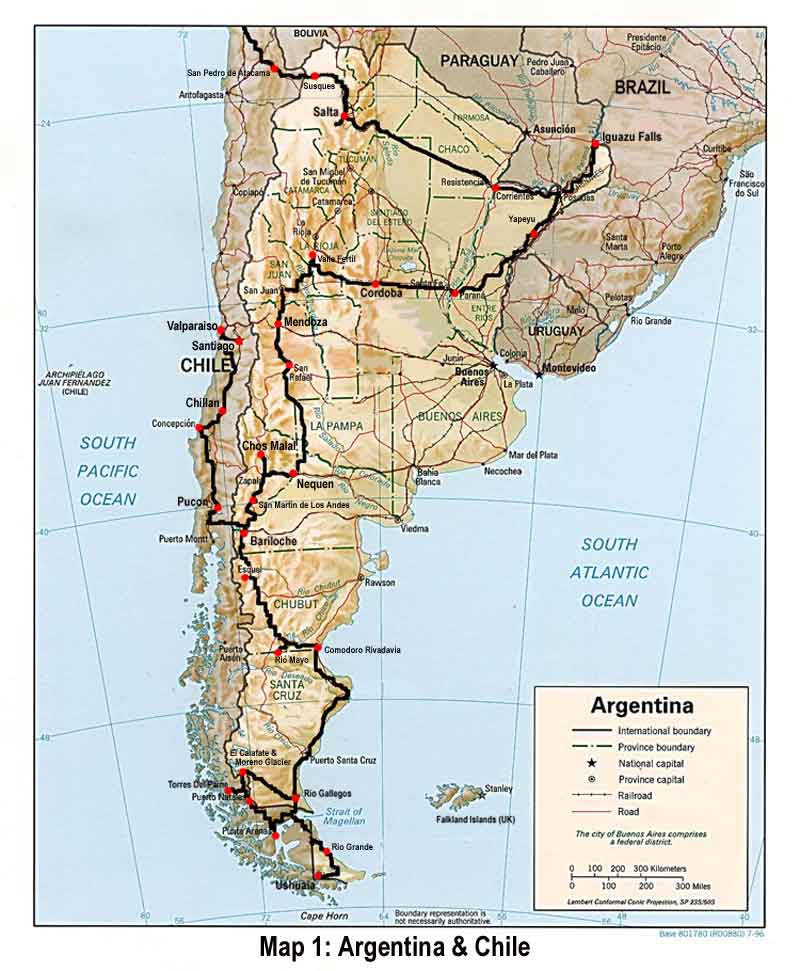
9th January 2004 – Chile – Viña Del Mar Well, here we are all safe and sound and ready for the start of our grand trip in sunny Chile. The journey started on Sunday 4th when we left London to miss our connecting flight in Paris to Santiago. We had an unexpected delightful day of rest in Paris at the expense of Air France, as they caused the delay leaving London. We finally left on the evening of the 5th January arriving in Chile at Santiago at mid-day on the Tuesday 6th. We decided to rent a car (at US$44 a day) for the first few days until we sorted out the release of the bikes. Our first evening in Chile was spent in the area of La Providencia in Santiago and to be honest it felt more like the Costa del Sol than Latin America with its proliferation of bars, restaurants & nightclubs. Still we got to the nearby Kuehne & Nagel office (our shipping agents) where we quickly sorted out what needed to be done to release the bikes, which hopefully were waiting in storage in Valparaiso. In our initial impressions of Chile, we were immediately struck by how open & friendly the people are. Everywhere on our first day - from the car rental office, the hotel receptionist and then meeting all of the staff including the lovely Catalina at K&N office – we were met by smiling friendly people who really went that little extra to help. Catalina arranged a customs broker for us in Valparaiso to do all of the necessary paperwork for the bikes and we set off early next morning for a 9:30 appointment with Jorge Meza at his office. It took us from 9:30am to 4pm to secure release of the bikes from customs, taking the necessary paperwork from Jorge’s office to the Aduana (customs house) to obtain the release papers for the bikes, with side trips to the port authority & back to the office. Ingrid - a lovely young girl from Jorge’s office - stayed with us all day including the trip out to SAAM, the depot where the bikes were actually held in bonded storage. Ingrid was full of smiles & laughter, with a lovely way with people that easily smoothed over any queries or comments on the paperwork. At SAAM we were surrounded by a gaggle of young warehouse personnel, male & female, who were all interested in what was coming out of the crates. They carefully crow-barred the wooden crates apart, this effort being led by the jokester Pedro and by 7pm, both bikes were finally out, had their batteries reconnected and a gallon of petrol added. We were chuffed to bits when both started first time after being at sea for 2 months! Everyone we met today was very professional and helpful towards releasing the bikes. There was not the slightest whiff of bribery or corruption, but a lot of interest in our forthcoming trip. Once the bikes were released we rode to Viña Del Mar, a rather upmarket seaside resort where we have spent the last few days sorting out our kit & the bikes in the lazy sun. The weather has been cool & grey in the mornings at the coast but hot & sunny in the afternoons with temperatures in the low 20˚C’s, which is fine and not too hot. Viña has the feel of a Mediterranean resort with prices to match, but it has been a lovely place to break us into our trip. Our main drawback to date has been our lack of Spanish - we just didn’t have enough time to learn anywhere near enough to get by. Still we are managing OK in English, French (which we used all day with Ingrid) and a little German (with our hotel receptionist) and we are slowly picking some Spanish up the hard way - through necessity! 20th January 2004 – Argentina – San Carlos de Bariloche We have now been in South America for 2 weeks and it just gets better and better. From Viña we rode south to Chillan, picking up the Pan American Highway for the first time. It has the appearance of a motorway – dual carriageway in very good condition, with toll sections in places. However unlike motorways in Europe, it comes complete with pedestrians, cyclists (going the wrong way of course on the hard shoulder) chickens, geese and all manner of critters and animals. Not in vast quantities but they are there occasionally and you need to look out for them. For services, just pull over at one of the many food shacks that line the way around major towns and tuck in to some tasty empanadas (a bit like delicious Cornish pasties) or lovely salads & fruit. We’ve been taking it easy, content to cruise along at 60 mph with both BM’s yielding a very respectable 70mpg at this low speed. From Chillan we headed next to Conception where we visited the Talcahuano Naval Base where the old Ironclad, the Huascar, is kept in pristine condition as a museum ship. She was built in Birkenhead in 1865 for the Peruvian Navy but subsequently captured by the Chileans in 1879 during the War of the Pacific and they’ve kept her ever since. We met the ex-base commander, the charming Mario Mulsow - Captain (retd) Chilean Navy - who insisted on giving us his contact details in case we should need any help. We have been quite staggered by the hospitality of the Chilean people. They are very open and friendly, with warm smiling faces and everyone says Hi! In restaurants & cafes, you don’t just get good service; you get good service plus that little bit extra that makes your visit feel special. We rode next to Pucon in the Chilean Lake District through ever increasingly beautiful scenery. Pucon sits at the foot of the Volcan Villarica. We found stunning camping under an apricot tree in the Camping Parque La Poza and were so taken in by this beautiful place we stayed for 6 nights. In the middle of our stay we spent a day ascending the volcano. Neither of us had ever seen a real live volcano before but Volcan Villarica fits the bill for a first. It is your classic volcano – a big pointy mountain that juts well above the surrounding scenery with snow on the top & a whiff of smoke coming out of it. The ascent involved going with a tour group of 9 people. The trip cost around ₤25 each including the services of some excellent guides, the bus to the volcano & ski lift up the first part and all special kit required – good snow boots, waterproof jacket & trousers, mitts, backpack and a wicked ice pick. It took us about 4 hours to climb to the top through snowfields and over volcanic rock & debris fields. It was relatively easy but the views from the top were out of this world, both looking out at the surrounding country and looking in to the smouldering & sulphurous crater. But the best it of all was coming down! Our trousers encompassed plastic bums and we used these to slide down the mountain via a series of chutes in the snow using the ice pick as a brake. Big smiles all round at the bottom, which we reached in just over an hour thoroughly exhilarated by the slides. It was with great sadness that we left Pucon. It was a real paradise and at nights the town itself was very lively with a variety of bars & restaurants. It is quite cheap here in Chile. Petrol is 43p a litre (Beer is slightly more expensive at 50p a litre!) and a cracking top-rate meal for 2 can be had for around ₤20 with all drinks & wine included. Not that we are living the high life – we had some good evenings in the campsite where we cooked our own grub and supermarket prices are very low – again a top-rate dinner for 2 with beer & wine costs around ₤4 - ₤5. From Pucon we rode south to Osorno, then turned inland to head to Argentina over the Andes for the first time. At this early stage of the trip we are running out of superlatives. Pucon, with the Volcan Villarica, was lovely, stunning, beautiful, wicked, cool. Now as we rode to Puyehue we were met by a fantail spread of 5 Volcanoes across our horizon, including the pointy witches hat that is Volcan Puntiagado and the awesome Volcan Osorno. How can we describe this vista? It sent electric shivers down our backs – making hairs stand on end at the thrill of seeing all this beauty. The Andes backdrop – stunning in it’s own right was simply ordinary against this lot. Check out also, the cool blue Lake Puyehue running past us on our left as we ascended past the volcano of the same name. Add to that a road that was pure motorcycling nirvana, bending and twisting up into and over the Andes. All under a cobalt blue South American summer early evening sky. The border crossing to Argentina was a simple transaction with very polite policemen and customs officials on both sides. Then we were off to San Carlos de Bariloche, gateway to Patagonia, twisting down into yet further changing scenery – the mountain roads lined with powerfully scented lupins in the late evening as we trotted down through a pink & purple sunset and around lake Nahuel Huapi, to our destination. As we arrived late, we found a decent hotel room for 80 pesos a night. We had no idea what the exchange rate was (the decision to cross into Argentina was made at the last minute today) and were a bit worried that it would blow away our daily budget allowance. We got some local money from an ATM and then had the best meal of the trip so far – Trucha con Hongos with some excellent local Patagonian wine – at the Breogan, a Spanish Celtic restaurant near the hotel. The meal was recommended by our waiter – a very professional Brazilian called Jose Alfredo Ost – and was local trout in a sauce made from Hongos – a local tree growing mushroom. Never tasted trout like it, never tasted mushrooms like it! With obligatory Pisco Sours as a starter (made from Pisco – a grape brandy - egg white, sugar & lemon or lime juice) it all came to 45 pesos, including the tip. You can imagine our surprise and delight when we found out next morning that there are just under 5 Argentine Pesos to the pound, so that stunning meal for 2 came to less than ₤10! San Carlos de Bariloche is a delightful place, a small city with a very Bavarian/Germanic feel to it on the shores of Lake Nahuel Huapi and we decided to stay for a few days to familiarise ourselves with Argentina and Patagonia before heading further south. We have completed just over 1000 miles in the 2 weeks – a slow pace, but we are loving and savouring every minute of it. 26th January 2004 – Argentina – San Carlos de Bariloche to Rio Mayo Argentina was a country we had low expectations of before this trip. We initially viewed it as just a transit place to get through to visit the southern jewels of the Moreno Glacier, Torres del Paine & Ushuaia. And as to the people, the only Argentineans we’d ever set eyes on were on TV back home and consisted of some dejected looking POW’s in the Falklands war and Maradonna cheating in the World Cup! So what a surprise it has been to discover that Argentina is an incredibly marvellous place. We’ve been in Patagonia for 6 days now and it is simply spectacular in every aspect. And the people – well, the Chileans were friendly but in Argentina we’ve met one of the kindest, most easygoing people in the world. They are lovely! In Bariloche, we had another culinary marvel – a visit to a Parilla. A Parilla is a restaurant containing a huge metal grilled barbeque, reminiscent of a medieval torture rack complete with a chain ratchet mechanism for raising & lowering it, on which huge quantities of beef are roasted over an open fire. The one we visited was called ‘Refugio des Montanes’ a small family run business. On entry you are confronted with a huge wooden butchers bench on which select cuts of meat are prepared. We opted for 400g Bife de Chorizo (Sirloins) cut around 40mm thick and cooked ‘a punto’ (medium/rare). They were served with papas fritas (chips) & chimichurri – a delicious green paste made from oregano, coriander, loads of garlic & chillies infused in a mix of olive oil & vinaigre. I don’t think we’ve ever eaten in a place where the staff were so happy to recommend & serve you your food – in fact they were truly delighted to serve you and needless to say – Best Steak in the World (so far!!!). From Bariloche we rode south and into the wind-swept vastness of Patagonia. We did a 300-mile day across a spectacular barren landscape the colour of Spitfire camouflage, tearing along the road, scattering little tan backed birds from the hard shoulder as we sped along. We ended up in a little place called Trevelin, a Welsh settlement where Welsh is still spoken today. Here we visited Nain Maggie’s Tea Room. Maggie of the tea house was born in 1878, migrated to Argentina in 1891 & then lived here, running the tea room, until she died in 1981 at the ripe old age of 103. We ordered ‘Te de Galles’ or a Welsh Afternoon Tea consisting of home made bread & butter with cheese, homemade strawberry & cherry jams and an assortment of scones and scrummy pastries. Carbohydrate Heaven!!! We were so stuffed we decided to skip dinner that evening. Our bikes by now are now looking slightly the worse for wear and look like real travel veterans. Patagonia is very dusty and everything gets coated in a film of thin brown dirt. You get absolutely filthy just loading the bike and it is pointless trying to keep them clean. On the road south we met 3 Mexican guys, Joaquin, Jose & Muceo riding respectively a BMW 1150GS, Honda Varadero & a Honda Africa Twin, travelling under the guise of Los Tres Amigos! They are doing Mexico to Ushuaia and rode down through Venezuela & Brazil, the latter of which they absolutely raved about. We decided to travel together for the next few days as we were all headed in the same direction, stopping at Rio Mayo at the start of a bad bit of of-road section of the infamous Ruta 40. Rio Mayo was a bit of a one-horse town but its saving grace is the hotel residencia ‘El Viejo Covadonga’ run by Teresa Basiloff, where for around ₤7 a night you can have bed, breakfast & evening meal. There is no menu, you just have whatever is cooking that day and it is excellent wholesome food served by very friendly staff. Oh and the bikes get lodging as well in the old function room at the back of the hotel (it was good fun riding through the lobby to get there). We set off on Saturday 24th January onto the Ruta 40 for our first taste of riding the Ripio (gravel roads) but it almost ended in catastrophe, when Mags had a fairly spectacular spill after some 20 odd miles on the road. I have to say that neither of us has taken easily to riding off road. It’s not something we’d ever done before and regarded it as more of a necessity on this trip rather than something to look forward to. We’ve done a few miles to get down here but this was the first serious stretch and it turned out to be one of the worst roads imaginable. We were getting on just fine, taking it easy & gradually building up our speed as our confidence grew. Then we hit a nasty patch of thicker gravel & both bikes began to fishtail. I was fully occupied, concentrating on trying to hold a straight line, when I saw Maggie lose it when the fishtail evolved to a high-side & she was off – down like a shot buffalo! It was horrible as the bike went across in front of me, upside down & I couldn’t see Mags. Both ended up in a big ditch at the side of the road. Fortunately both were OK. Mags was a little shaken & shocked and had hurt her left arm. The bike was a bit twisted up at the front top end of the fairing, but it looked to be mostly cosmetic damage. The 3 Amigos arrived on the scene shortly afterwards and helped us get sorted. We headed back to town with Mags on the back of Joaquin & Muceo riding her bike. They left us at the hotel & shortly afterwards we went to the local hospital, where a quick X-Ray revealed a small fracture in her elbow. It is a minor fracture only (about 1cm long) and they set her arm in a cast, which will be on for 20 days. She is absolutely fine & now 2 days after the accident there is no pain. The staff in this tiny little outpost of a hospital were excellent and thoroughly professional throughout, refusing to accept any payment for the treatment – in the end we had to insist on them taking a charity donation for the hospital. Back at El Viejo Covadonga, we spent the next day sorting out the bike. It all straightened out and in the end the only permanent damage was a broken off-side wing mirror & that can be replaced at the next bike shop. One of the tank/fairing panels had a crack in it but we melted holes in it with a nail & sewed it up with nylon thread & filleted it with some epoxy adhesive, so the little bike has a permanent scar from the bash! We cannot now continue on the bikes for the next 20 days until this arm is sorted but we need to get to the southernmost part of the trip before the weather turns too bad. Also Rio Mayo is not a place to dwell in so we are now contemplating routes by bus or rental car to see those aforementioned jewels of the southern parts of the continent – the Moreno Glacier, Torres del Paine & Ushuaia. This will give Mag’s arm time to heal and allow us to continue with the trip. The bikes are staying here in the hotel, where the lovely Teresa has kindly promised to keep an eye on them. Saturday 31st January – Comodoro Rivadavia to El Calafate News of our mishap travelled fast around Rio Mayo and next thing a guy called Lito called into the hotel asking about the crazy gringo’s who’d had the accident. Lito is a bank courier and every day he drives from Comodoro Rivadavia on the coast (where we can get a hire car) to Rio Mayo & back again. He offered to take us in the back of his van – an offer we leapt at as the daily bus leaves at 6am in the morning. It was great as he didn’t leave until 2pm and we could stuff all our camping gear into his van. He duly turned up & not only did he take us to Comodoro, but he took us to the bus station to enquire for costs / times for tickets south to Rio Gallegos and he showed us a number of hotels recommending the excellent 4-star Hotel Austral as a stop over (cheap at ₤20 a night for the 2 of us). Lito is yet another example of the outstanding hospitality we’ve found in Argentina and he has offered to drive us back when we return hopefully with Mag’s arm mended. Comodoro Rivadavia is the centre of the petro-chemical industry in Argentina – there were oil heads all around on the road into town and the town even has a petrol museum! We found a VW Golf (or Gol as they are known here) and arranged a 3 week rental and set off south for Rio Gallegos and then across to El Calafate & the Moreno Glacier. The drive to Rio Gallegos and the next day west to El Calafate took us through the amazing landscape of the Patagonian Pampas – vast areas of flat rolling grasslands. We saw groups of Guanacos (‘ginger’ llamas), Rheas (mad South American Ostrich/Emu type birds) and lakes full of pink Flamingos & geese. It is an awesome place – very bleak & desolate but with a strange compelling beauty. It’s like a planted desert – there is nothing here but it is still a beautiful place. We also experienced some of the notorious winds as we drove through a late afternoon squall just before Rio Gallegos.
Rio Gallegos wasn’t too pleasing to the eye – a windy desolate looking place that smelt of gas - but an essential one-night stop over. But never judge a book by it’s cover - we met a really nice restaurateur called Guillaume who runs ‘La Estancia’ – an excellent Parilla / Asado joint (it looked to be the best in town). In addition to serving us a decent dinner, he also answered some of our queries concerning roadside shrines in Argentina. There are 2 types – the first have what looked to us to be a little house with the Virgin Mary inside & these were surrounded with plastic Coke bottles full of water. The second type was another little house, this time with a male saint inside but surrounded by red flags making very colourful roadside displays. Guillaume explained that the first type of shrines are ‘Di Funta de Correa’ and the second are shrines to ‘Gauchito Gil’. Correa was a family name of a lady whose husband abandoned her with her child. She set off with the baby to find him, across a desert in the north of the country where she perished under the harsh sun. However when other travellers found her body, she still held her baby to her breast, nourishing it with her milk so that it survived. This was hailed as a miracle and shrines sprung up all over the country – made by travellers (mostly truckers & people who drive for a living) where offerings of water (in the Coke bottles we saw) are left in return for safe journeys.
Gauchito (Little Cowboy) Gil (pronounced ‘Heel)’ is a similarly tragic story only this time it concerns affairs of the heart. The hero falls in love with the daughter of the owner of the Estancia (ranch), but when the father hears of the affair he is dead against his daughter having anything to do with a lowly cowboy - a person very much below her station. So he has the hero – Gauchito Gil – taken out into the desert and beaten up & left for dead. However the hero manages to crawl dying to his love for one last kiss, leaving a trail of blood across the desert on the way – hence the red flags. We had a closer look at one of the shrines & what we thought was a saint is actually an effigy of a little cowboy (likewise, in the Correa shrines the little statuette is of a dead woman suckling a baby). Red flags are hung out for help with matters of the heart and we were both very moved by both of these stories and their physical presence in the number of shrines for both types across the country.
Our final stop on this road was El Calafate – a place more akin to a North American mountain town and stopover for visiting the Moreno Glacier. We found a Cabaña for hire for a few nights in ‘Cabañas Nevis’ run by a third generation Scot called Ansell Campbell. His family had been in sheep farming but he gave it all up as a bad job (he hated sheep with a passion!) to get involved with the tourist industry instead running these lovely little pine cabins here in the mountains. From our window we have a stunning view of the snow-capped Andes out across the turquoise blue Lago Argentina – 3rd biggest lake in South America – it really is a wonderful location. On the road today, we had another wildlife encounter this time observing about 12 birds of prey feasting on some dead hares at the side of the road, whilst overhead a huge Condor speculated on the scene. The birds were a mix of some fawn coloured hawks and some little eagle type birds, which we later identified as crested Caracaras. We are now approaching some of the highlights of the whole trip – the Moreno Glacier, Torres Del Paine National Park and Ushuaia at the bottom of the continent. In spite of our setback at losing the bikes, we are still glad to be continuing the trip as the really important thing is for us to see these places. Mag’s arm has settled down fine and we can do these things with minimal interference from it. It is coming up to the end of our first month on the road and the only second thoughts we are having about the trip is that we should have done it years ago! It has been one of the most fulfilling periods of our entire lives!
|
|
|