|
|
|
CHAPTER 5: Iguazú to Salta
Sunday 21st March 2004 – Argentina – La Aripuca & Güirá Oga Before exploring the Falls themselves we had a lazy Sunday at the Cabaña, where we took some short walks to find some hidden nuggets right on our doorstep. First off was ‘La Aripuca’ – a wonderful world of wood! The entryway was through the stump of a dead rainforest tree. The tree had been killed by Termites, who had hollowed out the inside of it to make their nest & then fungus had set in to weaken and eventually destroy the tree. It had been brought here by lorry and worked into a magnificent gateway to what could vaguely be described as a museum of trees & wood. The owner, an enthusiastic chap explained the origins of the park, which contained several wooden buildings, made not from planks but from curved sections of tree trunk pinned together to make fantastic dwellings. We were shown an Aripuca – a Guarani Indian bird trap from which the park takes its name – a small bamboo pyramid shaped cage, where the bird comes in to eat food off a stick that causes the cage to fall, trapping the bird. The centrepiece of the park was a 500 tonne ‘Aripuca’ made from entire tree trunks to create a cavernous open wooden structure that can be rented out for functions & special occasions. It was a thing of immense beauty and we stood twirling in the centre of it, looking up at the lofty ceiling of wooden roof tiles, feeling like 2 small birds trapped in a very big cage. There were also crafts for sale, including some incredible furniture made from whole cross sections of tree roots that had been worked and polished to create a selection of tables and chairs – each one totally unique in beauty and form. La Aripuca was a really special tranquil place and should not be missed on a visit to Iguazú. It was also in part a protest against deforestation, by showing how beautiful the trees are by working with them to produce these majestic structures and furnishings (all of which were made from already dead trees). The owner reckoned we are all living in a global ‘Aripuca’ and one day the trap will spring and it will be too late - we will be caught like birds in a giant Guarani trap. Cheery Chappy! In the afternoon, we visited Güirá Oga – a bird sanctuary to admire some exotic birds. We had a short, guided tour by a young chap called Ricardo who walked us around spacious cages containing birds that had been handed in by the public for recuperation & repatriation to the wild. It was a moving experience, sometimes amusing, to hear where the birds came from. Most had been accidentally shot by hunters and brought in for veterinary treatment & repatriation. Others had been pets – including a monstrous Common Black Vulture that someone had kept in a 5th story apartment in Mendoza! The saddest of all were the customs finds from illegal trading in endangered species. There were some Talking Parrots – beautiful bright green birds that are bleached and then painted to look like more exotic, more expensive parrots. The birds of course die a few days after the sale is completed. These ones had fortunately been found before any bleach could be applied. There was another parrot, whose livelihood is threatened as they only nest in one type of tree, which has almost been eradicated by deforestation. The birds simply will not / do not know how to nest in other trees and so are now an endangered species. Most heart breaking of all was a beautiful Great Toucan – you know the black one from the Guinness ads with the vivid yellow & red beak, white throat & bright blue eyes. This Toucan was recovered by customs officials in Buenos Aires, from a passenger boarding a flight with a suspicious looking Thermos Flask. The flask’s inners had been removed and the poor bird stuffed inside to be smuggled out of the country. Miraculously it was still alive and sent to Güirá Oga where it now has a mate and is nearly ready for release back into the wild. Ricardo was an enthusiastic guide and it was his last day as was off to Tucuman to start training to be a Forest Ranger. The training involves running, climbing, swimming & horse riding as well as learning about plants, animals and land management. We wished him well, sure that he will make an excellent ranger. Tuesday 23rd March 2004 – Argentina – Iguazú Falls We spent yesterday on the Argentine side of the Iguazú Falls. If you have a passion in life, a hobby or even a general interest then there is always some focus, a heaven, a consummate collection of whatever it is that has caught your eye. For example a train spotter may drool at the prospect of a visit to York Railway Museum. Aviation enthusiasts may dream of visiting Duxford to see all the old aircraft. If waterfalls are your thing, then Iguazú is the Mecca! It is a veritable museum of waterfalls with all types available. There are single falls, double falls, multiple falls, curtains of water, chutes, deluges, dribbles, spouts, sprinkles, spills, sprays, trickles, tinkles – you get the picture? The falls are caused by water cascading off the edge of a basalt lava field, the largest in the world. Where the lava stopped flowing it left an enormous 70-metre precipice over which the Rio Iguazú spills. There are somewhere in the region of 275 different waterfalls in the vicinity making for a visage of aqua on a grandiose scale. Generally with an ‘ordinary’ waterfall you have a river reaching some precipice over which it plummets like pouring water from a jug in a more or less controlled and directional manner. At Iguazú it is more like trying to pour water off a plate or a tray – it just goes everywhere! As it is so vast, there are a number of trails to explore the falls, all of which are reached from an excellent visitor centre by means of a small train. We started with the biggie ‘Garganta Del Diablo’ – the Devil’s Throat! The trail out to the falls on a metal catwalk over the river gives no hint of the deluge to come until suddenly you are upon it and simply confronted with the biggest wall of water imaginable gushing straight at you. It was a scene of biblical proportions - it really took our breath away and made us take a step back. This is what ancient mariners must have envisaged when thinking of sailing to the edge of the Earth, masses of boiling frothing green-blue water hurtling off the edge of the planet and into oblivion! And all around the green jungle canopy, highlighting the colours of the water in the falls. When she visited Iguazú in the 1930’s, Eleanor Roosevelt said “Poor Niagara”! In the afternoon we visited the ‘lesser’ falls that run between the San Martin Falls & the Salto Bosetti. It was hot but bearably so and trails led us through the cool shade of the forest, which would suddenly open to yield ‘Lost World’ vistas of the falls and blow our minds even more. This area is sub-tropical jungle and actually suffers occasional frosts in the winter. We took the free ferryboat across to the Isle San Martin (the guy gets his name everywhere!) and followed more trails for yet more views. The digital camera Flash card was soon full, with 130 odd photos – we’d both gone snap happy and this was a rare occasion when we had to use the spare card. At 3pm we set off on a ‘Jungle Explorer Tour’ consisting of a ride in a very fast inflatable raft up towards the Devils Throat and then into the deluge at the bottom of the San Martin cascades. It was cracking fun and everyone was drenched! Then we blasted over some fairly easy rapids down the Rio Iguazú to join a truck for an 8km jungle trail tour, where we learned a little about the forest & its inhabitants. We finished our visit with a walk along the Superior trail leading us out over the top of the San Martin / Bossetti Falls. We have described the Falls above but there are some incredible animal attractions as well. Take butterflies for example – On the little open air train on the way out it was like a gaily-coloured tickertape parade with all colours of butterfly - bright reds, yellows, blues, oranges, greys - in every possible colour combination all flying alongside the train as if commuting to some butterfly metropolis to do a day’s work. The park also contains Jaguars & Pumas along with lots of not so dangerous mammals and over 400 species of bird. We did have one disappointment ‘though. There were signs up everywhere saying “do not feed the coatis”. These are cute little ring tailed mammals with a longish snout and have recently turned into park bandits, performing daring acts of robbery, pilfering visitors of any food items on display. We desperately wanted to ‘not feed’ the coatis, but there were none around not to feed! We wandered back to the visitor centre at the end of a magnificent day, where we picked up our crash helmets from a secure locker facility. Although it may have been secure against human infiltrators, the lockers were not secure against Termites, who had moved in and decided that our helmets would make a great new nest. They were everywhere – in all of the air vents that line the helmets and we spent the next 3 days clearing the little buggers out. Iguazú rates as one of the greatest natural wonders we have ever had the privilege to see. It is right up there with Yellowstone & Torres Del Paine – Mags was having fits coming home trying to decide which one was best! Maybe they deserve a joint crown? Wednesday 25th March – Into Brazil! Today we crossed the border for a look at the Brazilian side of the falls. As 80% of the falls are in Argentina, the Brazilian side was a poor second. Still it did offer good panoramic views over the array of falls in Argentina and also an encounter with the Salto Santa Maria. Best of all was a chance at last not to feed the Coatis! A small troop of the little bandits was hanging out around the food stalls, looking cute, posing for photographs and hoking the bins for scraps of food. In the afternoon we visited the Itaipu Dam, a joint Brazilian / Paraguayan project that is the biggest hydroelectric plant in the world. The visit was free and consisted of an introductory movie at the visitor centre and then a coach ride out to see the dam – an ugly wall of concrete, that made for an excellent siesta on the air conditioned coach! We returned to Argentina after an hour of hassle getting through the messy Brazilian border checkpoint (2 guys handling all the ‘ins’ & ‘outs’ at one desk, neither of them seemingly interested or clued on the due processes). The confusion was caused by a group of Israeli kids who had thrown their entry visas away thinking they were useless bits of paper and a Scottish guy who had previously left the country at Rio de Janeiro, without getting an exit stamp. $50 fines all round amidst howls of protests & abuse, whilst we had to wait whilst more forms were filled in and processed. Fortunately we had collected the appropriate stamps in the morning so our departure was quite straightforward.
Sunday 28th March – Across the Gran Chaco, Victory against the Snakes and on to Salta!
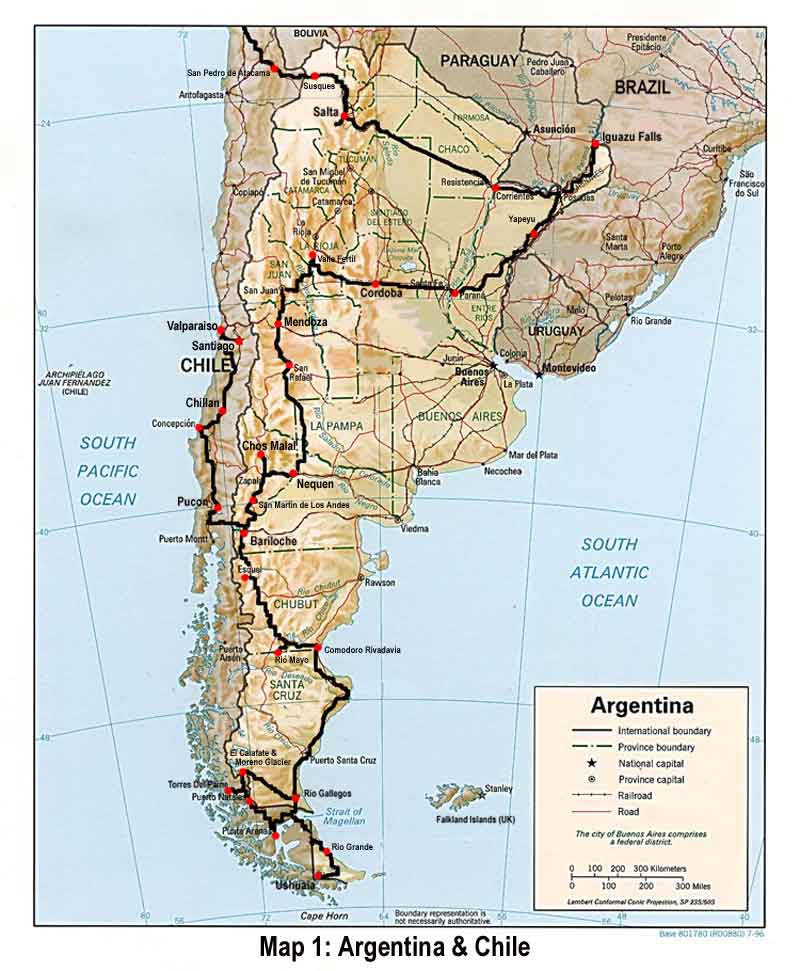
Thursday 26th March - we had a sad farewell with Monica Ponces, the lovely owner of the Cabaña Leñador in Puerto Iguazú. Over the 5 nights we stayed here, we both agreed that it has been one of our finest accommodations to date. It is set in a beautiful location with a jungly feel to it, complete with superb breakfasts and a swimming pool, which being out of season we had to ourselves. Monica made us really feel at home and let us have the run of the restaurant kitchen to cook our own food when we wanted to – when travelling for long durations, this option is not only cheaper but is a welcome change from eating restaurant / café food all the time. Our next target was Salta a 2 – 3 day 1000-mile ride across the Gran Chaco, where we had arranged to meet with Peter Deck, a fellow traveller riding a BMW GS 1150 around South America. We’d met Peter initially in Rio Mayo, the day after Mags had her tumble and we got on like a house on fire. Peter went on to Ushuaia on his GS and like us was totally absorbed with travelling in Argentina. He was currently staying with some friends in San Lorenzo near Salta where he was convalescing after a minor tumble on a local rocky road, in which he unfortunately broke his hip.
The ride out across the Gran Chaco promised to be boring – the road on the map looks like someone drew it with a ruler, running straight as a die for some 600 odd miles. It was boring but again we were in for another game of snakes & ladders. On the early stages it was enlivened by spectacular grass fires all around us giving it the resemblance of a battlefield after an air strike with huge columns of smoke drifting up into the afternoon sky and on occasion blotting out the sun. We had an overnight stop in Corrientes a confusing jumble of a city but with a spectacular dawn ride out across the impressive General Belgrano Bridge taking us back across the Parana River for the last time. Day 2 on the Chaco was good miles on good roads and then all of a sudden the snakes struck again. First the good road went bad, deteriorating into masses of potholes, which forced us to ride slower. Next up we hit another snake in uniform, this time an older guy on the state line between the Gran Chaco & Santiago Estera departments. We have been watching out for these checkpoints and have been through quite a number since our ill encounter last week with everything back to normal and happy smiling helpful policemen at each turn. This time however, I saw the old guy run out to stop us when he saw us coming and immediately knew that something was up. He took our papers and then pointed at my engine muttering something about ‘Mata de Fuego’ and $60 pesos per bike. When we failed to understand, we were taken inside and an ancient statute book that had been typed & photostatted some time ago was produced and we were shown the ‘Mata de Fuego’ section & asked to pay $120 pesos (around ₤25) or the 2 bikes. Official receipts were also tabled but again we noted our details were being recorded on a scrap of paper. This time we were two onto one. First we told him we had no money - we were living on credit cards and a cash machine had taken our cash card so we had no cash whatsoever. We explained that we were headed to Salta to see a friend who was baling us out with some cash but until then we had 2 apples & some water to see us through. Mags was particularly good at eliciting sympathy from the guy about our ‘dreadful’ predicament. We asked to speak with his officer but this was not possible (of course). He then dropped the price to $20 pesos but we re-iterated our yarn about the cash machine and no cash etc and he finally gave up, returning our papers to us. It was interesting that he thought we were Germans and couldn’t understand how Germans would not have cash (presumably they pay easily?) and we had to explain that we were from Ireland and therefore very poor, which seemed to do the trick! We rode off elated at the successful outcome of this second encounter with corruption.
The poor roads and the time wasted with bent cop number 2 saw us head into a cheap hotel in a place called ‘Joaquin V. Gonzalez’, completing the ride to Salta, back up in the Andes, by midday on Saturday. It took a while but eventually we found San Lorenzo and El Castillo, the place where Peter was staying. What a delightful surprise awaited! Sunday 4th April 2004 – Argentina – Salta, El Castillo, Good Company & the Road of Many Colours! Every now and again on a long trip like this, you come across a real treasure find. It may be some beautiful scenery, impressive architecture or a stunning road on the bike, but now and again it comes in the form of a special accommodation, an oasis on the road where you can rest in luxury, in beautiful surroundings, enjoying excellent food and the company of fellow travellers. We were now nearing the end of our stay in Argentina and such a place would be ideal to recharge our batteries and allow us to prepare for the next stage of the trip. The bikes too needed some fresh oil and new tyres and Salta offered the last major opportunity to do this before heading into the altiplano of northern Chile, Bolivia & Peru. Peter had told us a story of some friends of his who ran a wonderful hotel-restaurant set in an old Italianate Castle in the peaceful little valley town of San Lorenzo, near the city of Salta. He was currently in residence, recuperating following some surgery after his bike spill and we agreed to meet up.
‘El Castillo’ was built some 100 years ago by an Italian gunsmith called Don Luigi Bartoletti as an extravagant summer holiday home. He acquired the site by means of marriage to a rich Saltanian lady. It was an expensive undertaking - an architect was brought in especially from northern Italy to direct the work. Stones had to be brought in by mule for the construction and dynamite was used for the first time in Salta to excavate the foundations. In the end it nearly ruined Bartoletti and sadly in the early part of the 20th Century, the house was abandoned and became derelict. 20 years ago, John Johnston was a backpacker from Alabama, mooching around South America with half an eye open for a haven that he could refurbish as a stylish lodge & restaurant. Whilst in Salta he heard about the old ‘Italian castle’ in San Lorenzo a few kilometres outside town. John duly acquired the property and with his Chilean partner Maria renovated the place, first as a restaurant and later refurbishing the bedrooms to open as a hotel.
We reached Salta at midday on a Saturday and found it a hectic place to drive through. We both felt like Luke Skywalker doing a bomb run on the Dark Star in the first ‘Star Wars’ movie - running through narrow streets, dodging maniac taxi drivers and motorists, trying to decide who has right of way at crazy road junctions and in the end doing chicken runs just to get through! Eventually we emerged from the chaos onto a lovely 4-lane highway that took us out of the madness and up into the nearby hills to the delightful tree lined streets of San Lorenzo. Everyone there knows ‘El Castillo’ so directions were quick and easily obtained. Before long we were pulled up outside and exchanging hugs with Peter, who had hobbled out on his crutches to greet us.
What an utterly stunning place we had arrived at! The location is high up in the Quebrada (gorge / canyon) de San Lorenzo, surrounded by lush exotic flowering trees, from which protruded the red tiled campanello of the castle. We shouldn’t really use the English word ‘castle’ to describe El Castillo as this suggests some imposing stone walled fortress designed to keep people either in or out. True, the walls of El Castillo are railed with old Remington rifle barrels – leftovers from the War of the Triple Alliance, which presumably old Don Luigi bought up as a cheap job lot – but they now have tasteful little knobs on top such that you would never guess their original purpose. A palm shaded patio leads on to the grandiose arched doorway inviting the visitor to enter the lofty main dining area, where a crew of excellent waiters are on standby to answer your every need (service at El Castillo was second to none!). Throughout the building, the stone structure is wonderfully warm and open – soft red brickwork lines the arches and the stones themselves are selections from a palette of softer hues. Where the original idea and the business strategy comes from John, Maria’s touch is very much evident in the day to day running and in the attention to detail in the provisioning and furnishing of the place. Oh, we mustn’t forget to mention ‘the Beast’, which every good castle must surely have… In El Castillo, his name is ‘Beckham’ and he is a huge one-year-old St Bernard dog, daft as a brush, whose aim in life is to befriend everyone who visits the castle.
We planned to spend a few days at El Castillo, but in the end stayed for 9 nights! Part of this was due to the fact that no tyres were available locally in Salta for the bikes and we had to order some from BMW in Cordoba, so they took a few days to arrive. But we readily welcomed these delays as it gave us more time to soak up the hospitality and atmosphere of the Castillo. Usually accommodation comes in the form of a simple business transaction – you pay money and in return receive a service – a maintained room & bed, food, drinks etc. But at El Castillo we were absorbed into the lives of John and Maria who both went out of their way to look after all of their guests. Evening meals became dinner parties with other guests lasting long into the evenings with excellent cuisine (it is far and away the best in Salta) and mouth-watering local Cafayate wines. Peter is another American who works for the UN Refugee Agency and has been all over the world, mostly to trouble spots like Afghanistan, Bosnia and Liberia. In between missions, he takes off on his bike and was touring South America when he broke his hip. We also enjoyed the company of Kevin & Teresa from Maine, currently on a 2-week vacation in Argentina and as delighted with life at El Castillo as we were. Such an ensemble made for excellent company and with John and Maria at the table and whoever else was around, we had long nights of travellers yarns, tall tales and good banter.
Another benefit of staying at the Castillo was its location. Since reaching Salta, we have felt for the first time on the trip that we really are in South America. Everything south of here has a distinctly European flavour with Spanish, Italian, German and even Welsh influences to it. The local Indians have been mostly wiped out or are very small minorities occupying small-secluded areas. Even the scenery, awesome as it is, is more alpine than altiplano. But it was in Salta that we began to feel and hear the Andean influence strongly for the first time. Salta is a beautiful province in northern Argentina and the city is sited on a vast plain, ringed by awesome mountains wherever you care to lay your eye. Take any road out of town and you are in mountain wonderland. We spent a day on a 100-mile trip out on the Ruta 68, which runs from Salta to Cafayate. The last 40 miles runs though the Quebrada de Cafayate, an amazing twisty hardtop road that follows a riverbed through a multi-coloured landscape of mountains, gorges and valleys, which we dubbed the ‘Road of Many Colours’. It wasn’t just the colours of the rocks, but the textures and shapes too that were so impressive. It was another photographer’s nightmare with too many subjects begging to be snapped.
More locally, San Lorenzo had a lot to offer as well – we went trekking on up the Quebrada (5 minutes from El Castillo) following the little gorge up into the trees for views back over San Lorenzo. We also spent an afternoon horse riding out on the ‘Lomo Balcon’, a vast grassland just outside town with stunning views of the mountains and over the city of Salta. It was famous as the location for a Yul Brynner movie called ‘Taras Bulba’, in which thousands of locals appeared as extras on their horses dressed as Cossacks.
Sadly it all had to end as the road once again beckoned. The tyres arrived and were fitted, the bikes had an oil change and we needed to move on, to leave Argentina and head on, on our way north. Still time for one more treat! On our last Saturday night, John & Maria took us to a music bar called ‘La Caserna’ down in Salta. It was a big old single story house, with spacious rooms set around a tree-shaded courtyard and local artists simply turned up to play in each room with beer, wine & simple food on offer. Music ranged from typical Andean fare to simple but haunting folk melodies. We were invited to hear a young lad with his guitar and you could have heard a pin drop in the room such was the magic of his music, totally captivating every one of us. He sang some folk songs, and then an Andrea Boccelli operatic but our favourite was a tragic song about a beautiful old tree that was cut down to make firewood for a rich landowner.
At La Caserna, we also met an Englishman who has become a bit of a local legend. Sammy is a straight talking Yorkshireman, who arrived a few years ago, took a room and never left as he had been totally captivated by the wonderful atmosphere in this place. Legend has it that he also ran up a huge beer tab that he was never asked to pay! He sported a slouch hat from which two lively piercing eyes illuminated a slightly hooked nose. The rest of his form was indeterminate as he was draped in an old grey blanket poncho to keep out the chill of the night. Sammy sang a local folk song for us with the young lad on the guitar – he was a very passable vocalist - and later on I asked him if he had ever written any music. His one song was about La Caserna when it was closed down for a while a few years ago by a temporary owner who had no interest in the music. Sammy wrote about the bronze bust in the courtyard of the club’s founder and how it stood guardian over the vacant club, which now served only as the playground of the ‘Duende’ – the local ‘little people’ (pixies, fairies, leprechauns as they are known in other parts of the world), tending it carefully until one day it’s doors would re-open to the musicians of Salta. We left the club at 5:30am; the worse for wear with drink and lack of sleep but totally sated first from a week in El Castillo and then this wonderful music to send us on our way. Waking on the Sunday afternoon, I lay in bed trying to recollect the past evening and in particular this character Sammy. What a wonderful life – bed, beer and beautiful music, but it was strange, as I cannot swear that I actually met the man – was he a real person or was he really the Duende of La Caserna? |
|
|