|
|
|
CHAPTER 8: Trouble in Peru!
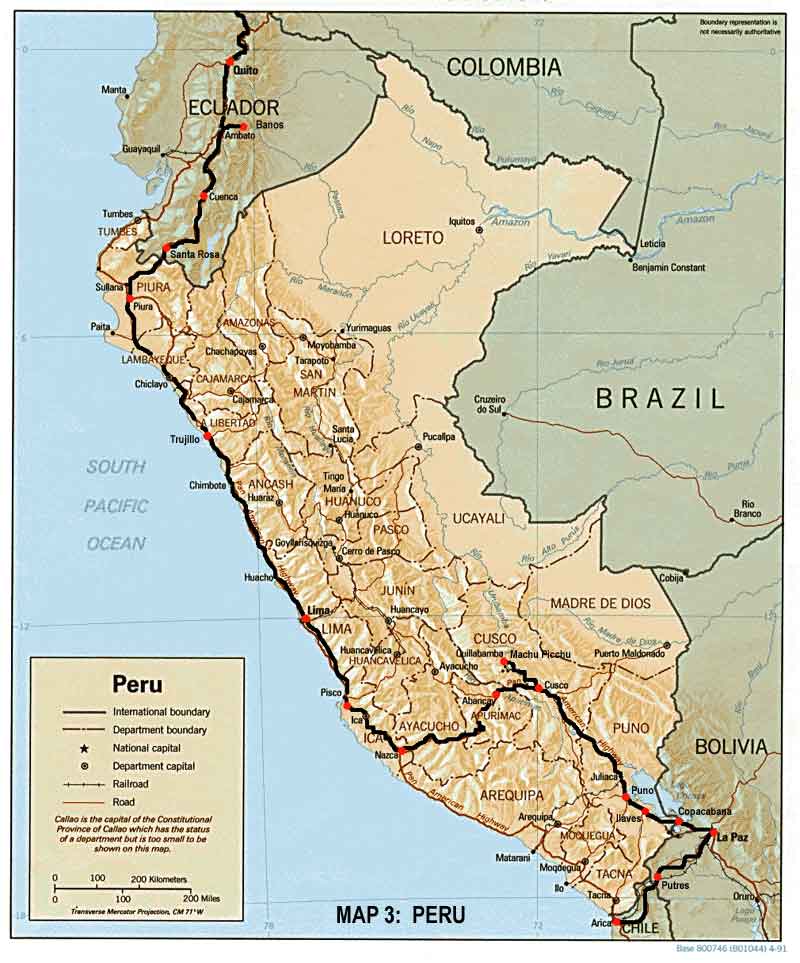
Monday 26th April 2004 – Peru – The Bridge At Ilave. We left Copacabana and Bolivia and rode the 8 miles to the Peruvian border. On the previous day we checked with bus drivers doing the Puno run as to the status of the blocked bridge at Ilave. Some good news! The passengers now had to decamp at the roadblock, then climb across the barricade to walk over the bridge where the Peruvian bus was waiting – a 5-minute walk instead of the previous 7km hike. Also there was some hope that the protest was all coming to a head and the bridge may even be unblocked today! Checking out of Bolivia took around 5 minutes and then a few hundred yards away it took another half hour to admit us into Peru. The customs guy showed us some newspaper cuttings of the situation up at Ilave and said that we may well be able to cross the river somewhere but to be careful. Yesterday we had met two Argentine guys on a Honda Transalp and a Kawasaki KLR650. We felt bad as we ruined their day by telling them about the bridge at Ilave (they had no idea of the situation there and had just finished a pleasing lunch on the lakefront when they met us). The customs guy said, sure they came through yesterday and hadn’t returned which could be a good sign.
On into Peru it was a 60-mile ride to Ilave along the western shore of Titicaca. It was another beautiful clear sky day with the blue lake shimmering on the horizon over on out right. The Peruvian countryside was a lot more orderly than Bolivia – the people working the little farms seemed happier and waved to us as we rode along through scenery again reminiscent of Scots-Irish Loughs. The road was deserted – not surprising given it was blocked up ahead and we soon had covered the short ride to Ilave. The first signs were rock chicanes across the road that we rode through easily but added as a warning that something was up on the road ahead. There were several burned out tyres here and there but thankfully no burned out vehicles. Then we were headed down a short hill with fleets of buses and mini-buses parked along either side allowing only a single lane of traffic to pass. Then it was there – the bridge. It was well and truly blocked by a huge sheet like a billboard with steel girders wedged up behind it. The town of Ilave was spread out across the other side of the river. First strike – we were not going to ride across that bridge.
Down at the bridge the situation was bedlam. There were vehicles everywhere trying to get down on to the riverbank to cross the river, which was wide but seemed shallow at the bridge. There were also minibuses trying to position themselves to carry passengers away from the bridge back to Bolivia. Mixed into this were hordes of local hawkers selling water, soft drinks and snacks as well as people just out to watch all the fun. We were soon caught up in the hopeless tangle, until a couple of locals managed to open a path clear for us onto a dirt road that lead east, away from the bridge towards Titicaca. From here we were able to stop & survey the situation. The bridge was blocked. A road lead upstream to the west and then curved down around and under the bridge to the riverbank 15 metres down below the road we were on. The problem was, a huge articulated lorry had gone down and was now stuck in soft sand under the bridge. A swarm of locals attended it like ants trying to dig out the wheels. I took a walk down to see if we could ride round it but it was hopeless. Meanwhile, Mags up with the bikes met a young chap who told her that the 2 Argentines had made it through. This guy & some friends had helped carry the bikes over the river on a lorry. There were 2 open back lorries down on the bank below and an old tractor sitting out in the river ready to pull them out if they got stuck. We were offered the same service for $10 a bike – it would be easy and all we had to do was to get the bikes down the 15-metre bank and onto the riverbank. I started to walk downstream to check out a muddy slope that looked promising and had not gone more than a few metres when we heard the roar of an angry crowd coming from the town.
The scene that unfolded was like something from a David Lean movie – you know Lawrence of Arabia or one of those epics set in India with a cast of thousands. Looking across the river streams of people were marching towards the bridge chanting and shouting. Smaller rivulets joined in from the side to swell the throng. The workers trying to free the big artic fled, as did all the locals and hawkers around the bridge as if an air raid was approaching. Van drivers were soon flying past us so we got on the bikes and joined the rout, riding a few hundred yards along the road to a safe vantage point where we could still observe the action. Strike 2 – we were not crossing the river at the bridge, at least not until the protest died down and peace resumed. We asked several locals what was happening and they said that things were coming to a head. They reckoned the row at the bridge would subside and that we were OK here and would be best to wait until it all died down. Then we could get down on the riverbank and get across on the lorry. It was really scary. Our retreat back to Bolivia was blocked. To do this we would have to ride past the blockade and it looked really hairy. While we were waiting we chatted to some of the locals who seemed friendly and fed up with the whole business. They didn’t care much for their mayor –a guy called Robles – it seems he was a bit of a crook and had refused to resign so they blocked the bridge. It had been blocked for 25 days now but recently things were stirring and it looked like today it might all be resolved. Looking for some way out of our desperate situation, we hoped that this might result in the bridge being unblocked. There were some kids around and we spent a while chatting to one of them in particular, a serious little guy called William who was interested in our trip and seemed keen to help us. He was only around 11 or 12 years of age but he would be an angel! Another young guy came up on from the bridge riding a mountain bike. Daniel was in his late teens and told us it was all very angry at the protest and we had best wait a while to see what would happen. We asked around if there was any other way across and a few people mentioned another ford downstream towards the lake and away from the troubled bridge. Daniel disappeared but returned about 15 minutes later saying that he had checked and we could cross there and get on the road to Puno.
As the position at the bridge remained unchanged, with lots of angry shouting and hurrahs, we set off to explore this possible crossing. We rode cross-country over farmland for about 3 or 4 kilometres and down a sandy shaly track following Daniel on his mountain bike. It was tough going on our fully loaded BMs and there were sections where we had to crawl through. Mags waited with one bike whilst I took the other down on to flatter terrain where we met a sharp-faced man who I took to be the landowner. He claimed not to speak Spanish (most locals speak the Indian Quechua tongue around here) and was angry with Daniel at bringing us to the ford. He was a stringy mean looking individual, an appearance enhanced by the cattle whip he held in his hand and from what I could gather he wanted to know how much money we had paid Daniel to bring us here. Daniel told him there was no money involved and I dismounted to try and negotiate a price for the crossing. Sharp-face man was not convinced - we had paid Daniel and he wanted to know how much. He started telling Daniel to go back but it seemed he was ready to do a deal with us, when all of a sudden the young kid William appeared from nowhere. He explained to the angry man that we were ‘medicos’ working for a Cancer Charity, that we were good people and that he should help us (he had picked this all up from our chat at the bridge, where we had explained our pannier logos). It did the job! Angry mans temper subsided and he took us all down to the ford and explained the best way to cross. I walked back up to get Mags and the second bike.
Unlike at the bridge, the river here was quite deep. Angry man had disappeared leaving William & Daniel to show us the way across. They had stripped down to their undies and waded over showing me where to ride. I had read a little of river crossings prior to the trip and to be honest had quite looked forward to having a go at it. However I had imagined riding through a bubbling little brook with water that just about covered the wheel rims on the bike. Here I would be riding through water that came over the top of my boots – almost up to seat level on the bike! I took KP, my bike first. It was about 300 metres to cross the river and the ford ran in an arched shaped with a sharp stone bottom. I took it easy staying in first gear with my feet down and using the clutch to pull the bike across bit by bit. Daniel & William led the way and we soon had the bike crossing the river. The aluminium panniers helped to steady things acting like floats to keep the bike upright. Near the far side, I stalled on a hollow and dropped the bike, fortunately away from the air intake side, which stayed dry. The 2 guys helped me right her up and she started first time to pull me on and out of the river. First success! The second bike was easier to bring over using a bit more power to ride across. The BMs were excellent throughout today and our faith in them has been restored as they pulled through the troubled terrain with ease. Mags waded over with our gear and that was it – we were across and ready for Puno! We said farewell to William at this point. He was a brilliant little kid and he saved the day for us with the angry farmer. His intervention completely defused a horrible dilemma. Daniel insisted on taking us around Ilave, as he didn’t think it was wise to ride through the town. We followed him on his mountain bike and he took us around the back streets of this most shabby and desolate place. After about 15 minutes, we were back on the tarmac road that would take us to Puno with the horrors of the bridge at Ilave safely behind us. We said farewell to Daniel. It was funny, neither he nor William expected any payment for their help and we had to insist that they take something. These two young chaps shine out as two stars of our Pan-American adventure and incidents like this, scary as the bridge scenes were, really restore your faith in humanity.
The short ride on to Puno was completed with no problems except for our wet feet from the river crossing. Once again people waved at us as we rode by elated at our successful negotiation of the river and our travels were again rewarded with a lovely little hotel – the ‘El Lago’, with smiling friendly staff who helped us unload our bikes and put them away safely for the night.
Thursday 29th April – Puno, Uros Reed Islands of Titicaca, Aftermath At Ilave, On to Cusco!
We had a day of rest in Puno where we booked up for another boat trip out on to the lake to see the famous floating reed islands – the Uros – and on to Taquile one of the bigger Peruvian islands. It was a great way to unwind after all the uncertainty and stress of getting past Ilave. The reed islands are simply huge beds of Totora reeds upon which the local people have built homesteads. There are two stories of how they came to live this way. One has them fleeing the persecution of the Incas, who couldn’t follow them out on to the lake and the other has them moving out here to avoid paying taxes to the Spaniards. The reeds are incredibly versatile with a tasty edible root (we tried some) and apart from providing the bedding for the islands, they are also used to construct the houses, furnishings and even boats and sailing craft used on the lake. The down side to living on this water is rheumatism by your late twenties, although the roots are even used against this. The visit to the islands was fascinating and we took a trip on one of the reed boats. The locals were all dressed very colourfully with lots of souvenirs on offer as, along with fishing in the lake, tourism is now their main source of income.
On to Taquile, where we had an excellent lunch of Pejerrey (King Fish) caught from the lake, before having a mooch around the island and its main town. The people here are descended from Spanish immigrants and still wear traditional Castilian dress. Once again the women are out doing all the manual work, whilst the men sit in the sun and knit all day, making fabulous woolly jumpers, hats and gloves to sell to the tourists! We enjoyed a sunny day with excellent company on our boat and Menelaus, a local from Puno, was a superb guide for the day, full of anecdotes and stories on island life and the flora and fauna of the area.
Back in Puno we found out that the bridge at Ilave had re-opened the day after our river trials but a horror story awaited. The disturbance at Ilave we had witnessed on Monday had certainly resolved the problem with the mayor. The locals had taken him out in the Plaza, convened a ‘Kangaroo Court’ and sentenced him to die, whereupon he was literally beaten to death and his body taken down & thrown off the bridge. The local police were powerless to act, held under siege in the local station by the mob. They had used up all their riot ammunition – tear gas, rubber bullets etc and had reached the point where they were ready to use live ammo on the angry crowds outside should they try and breach the walls. 400 National riot police appeared the next day, armed to the teeth and ready to kill, and order was restored. The Peruvians we spoke to in Puno and later in Cusco where horrified and a wave of revulsion spread around the country, with flags on public buildings and at our hotel flown at half mast in respect for the dead Alcalde. We asked around to see if he had been a bad man in some way but it seems he was no worse or corrupt than any other petty official and certainly did not deserve to die in this way. We were both really saddened by this news and it cast a dark shadow on our trip. Having visited the islands it was now time to take our leave of Lake Titicaca. A good paved road lay ahead to take us to the Inca capital at Cusco, where we were now resolved to walk the 4-day Inca Trail up to Machu Picchu, surely one of the greatest treasures of any visit to South America.
Tuesday 4th May 2004 – Peru – Cusco
It was a great ride from Puno to Cusco through more mountains with that old world Celtic feel to them, a twisty road that loved to play and had us arriving in the Inca capital with huge grins on our chops. Cusco is an amazing city, surrounded by more mountains than you could shake a stick at. Our plan was to find somewhere to stay, book for the 4-day walk on the Inca Trail to Machu Picchu and then organise somewhere to leave the bikes & all our kit whilst we were away. I left Mags with the bikes in the Plaza Regocijo and set off on foot to explore some likely accommodations. It was a fruitless search as the places were either too expensive or else didn’t have anywhere to park the bikes off the street. When I returned, Mags was chatting to an amiable local with the unlikely Hispanic name of Cecil. He knew just the spot for us – a good little hostel, quiet & we could park the bikes. Oh and he had contacts in the travel trade & could organise our Inca Trail trip and he was sure we could leave the bikes at the hostel. We were a little cautious at first, but decided to at least check out the hostel. The ‘Palacio Real’ was just perfect. A family run business up a quiet main draw, 5 minutes walk from the city centre; we were invited to ride the bikes into the dining room where they could stay as long as we liked. The room was spacious and clean with en suite facilities – exactly what we were looking for. We agreed to meet Cecil’s travel contact later in the evening to find out about the Inca Trail.
Alberto was a portly chap, an agent from Jenly Adventures (www.jenlyadventures.com) and he soon had us sorted out for the trail walk. We’d checked prices with friends we’d made up on Lake Titicaca and he was spot on. Also as the people we were dealing with were all associates, the bikes could stay in the dining room and a lock-up room would be available for our luggage so by the end of our arrival day in Cusco we had achieved all our objectives and could settle down for a few days rest to enjoy the delights of this lovely city. Access to the Inca Trail is strictly controlled and is only available with a guided group. Damage in previous years has seen new controls limiting the numbers of people on the trail to 500 per day (including porters & guides). It takes a minimum of 4 days for the tour companies to apply for your permit for access to the trail, providing an opportunity to rest up and stock up on supplies in advance of the walk. We met loads of fellow Gringos from Puno and Copacabana, which ensured a full social life in the following nights; sampling the free drinks on offer to tempt you into the various bars & clubs around the Plaza Des Armes, the main square in Cusco.
Cusco is the most beautiful city we’ve laid eyes on in all our travels in South America to date. Its narrow winding streets in the compact city centre are full of old colonial buildings raised on Inca foundations with evidence of the finely crafted Inca stonework everywhere. There are scores of bars, restaurants and souvenir and travel shops to spend your Peruvian Nuevo Soles or US Dollars in. Our favourites were ‘Jack’s Café’ offering superb cooked breakfasts and the ‘Norton Rat Bar’ – a cracking biker theme pub run by Jeff, an American travelling biker and Norton aficionado, who put down roots here in Cusco to open this wonderful watering hole on the main square. His beef burgers were truly delicious and best enjoyed on the balcony overlooking the Plaza where you could take in the action below. Inside darts and pool were on offer in spacious rooms lined with photographs from his travels.
The down side to Cusco is that everywhere you go you are hassled by hawkers and peddlers trying to sell rubbish you don’t want. It starts with a run past the shoe-shine boys offering to polish our Gore-Tex walking boots, then on to the gauntlet of kids selling chocolate bars, postcards & watercolours, then old women flogging woven water bottle carriers, belts, hats…it goes on and on. In the evenings add to this restaurant and café hustlers trying to get you into their place for the best meal in town with offers of free drinks & garlic bread. Later the nightclub touts are out with more coupons and tickets for more freebies. There are tourist police who are trying to minimise the interference but it is an uphill struggle. Even in the shops there is no peace. We reckon the word ‘browse’ is definitely missing from the Latin-American Spanish dictionary – as soon as you go in you are set upon by the custodians shoving T-Shirts & sweaters under your nose trying to make a hard sale. For all these hassles and aggravations, it is impossible not to fall in love with Cusco. Its hilly meandering streets are a delight to roam and the plazas, surrounded by arched walkways are spacious and splendid.
We also used our rest period to explore the various Inca ruins outside the city, taking a 20 km walk out to the old fortress of Puca Pukara as a warm up for the Inca Trail. On the way we visited the huge zigzag stone battlements of Sacsayhuaman, the ruined temple of Qenko and the Inca stone baths at Tambomachay. We also had a peaceful Sunday at the colourful craft market at Pisac, which was a lot less hassle than shopping in Cusco. But eventually the day drew nearer – Wednesday 5th May – D-Day – the day we set off on the 4-day walk to Machu Picchu along the Inca Trail. Sore feet here we come! |
|
|