|
|
|
CHAPTER 10: On Through Peru
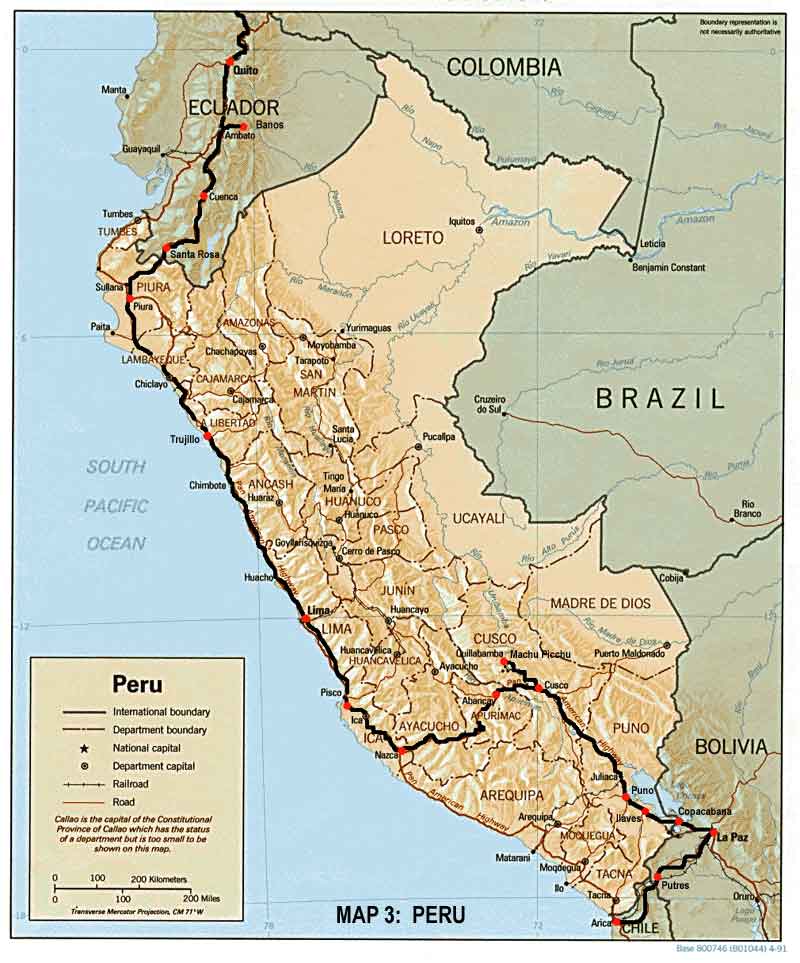
Sunday 16th May 2004 - Peru - Back on the Bikes and out of the Mountains; Candidate for the Best Biking Road in the World? No Moleste!!! Seabirds at Las Islas Ballestas; The Grey Road to Lima. Whilst we were shuffling along the Inca Trail and enjoying the delights of Cusco, our old bikes (they are getting very tatty now - real travel veterans, with scars and road damage to prove it) had been left for 10 days, unattended, in the hostel dining room in Cusco. We still haven’t sussed the cold / high altitude problem and it doesn’t look now like we ever will. We had an email from an insider at BMW in Munich (a friend of a friend) who contacted one of their development engineers who worked on the F650. Apparently the bike was never tested for combinations of cold start at high altitudes with low octane petrol such as can be found in South America. The bike also has a catalytic converter, which in hindsight maybe we should have dumped as we have run in to ‘leaded petrol only’ fuel stations in the Peruvian highlands. It could be that the catalytic converter is a contributory factor in the problem as the engine is managed by a computer, with sensors in the air intake, engine and exhaust pipe and it seems that if the computer doesn’t get the right answers the bike won’t start. Cusco is fairly high at 3300 metres and the dining room was unheated so we anticipated a nightmare getting the 2 bikes going, especially having been left for nearly 2 weeks. We pushed them out into the street and hey presto - both started first time! It was an omen for what would be one of best motorcycle runs of the whole trip to date. Our Lonely Planet guide (8th edition 2002) advised against travelling the road from Cusco - Abancay - Nazca, stating that it was unsurfaced in places and dangerous with reports of open banditry in previous years. It was bad news as avoiding it meant a 4 or 5 day backtrack towards Puno and down to the coast via Arequipa. In Cusco we met Soren Weihe, a Dane who runs a Harley rental business in town! He told us that this road is now completely paved and is one of the best biking roads imaginable - a 2 day thrill run full of twisty mountain passes and valleys. He advises all his customers to try it. We also read an account on the Horizons Unlimited Website from another Biker who had been through this route and he described it as ‘the Best Motorcycling Road in the World!’ We had to give it a go. We took the road in 2 stages. Day 1 was a short 120-mile run to Abancay, which took us around 4½ hours to complete. The road climbed out of Cusco and first took us on a fairly straight run climbing up into superb mountains with friendly locals waving as we sped along under brilliant blue skies. The interesting bit began when the road suddenly crested a rise to drop us into a huge valley via a series of fast bends running into hairpins and switchbacks, all on superb tarmac that were soon wiping off the hero blobs on our relatively new tyres. It was a battle between taking it easy to admire the passing scenery or concentrate on the road and get out there to have a good scratch! The road won by miles and even on our fully loaded bikes we had a blast lasting over half an hour to get to the bottom. Once down in the valley, where to next, but a corresponding climb up the other side! The road was made a little more ‘interesting’ on this part by the fact that the recent rainy season had washed away short sections on some of the hairpins to leave gravely riverbeds in full flow for us to traverse. Real action adventure stuff! We took it easier from here on exercising just a little more caution over the state of the road. Once out of the valley we were met with the sight of yet another fantastic winding descent, this time a final one into Abancay, which we could see far away in the distance below. A roadsign (one of the few) told us we had 30km of downhill slithery slalom to get to our goal. A fabulous ride and big grins all round when we reached the bottom. Even better, a lovely hotel - The Hotel Turistica with tree-sized red leaved Poinsetta all around in the gardens, giving it a lovely tropical feel. Looking at the distances only, it looked like we could have gone on to make it to Nazca in a day but Soren had recommended splitting the trip in 2 given the state of the road with all these fantastic bends plus the fact that it now gets dark early (we need to be looking for somewhere to stop around 5:30pm as it dark an hour later). It was good advice and next day we set off with a hill climb out of Abancay and then a drop into a cracking river valley that twisted and wound through gigantic canyons for miles again all under those Cobalt blue skies we have grown to love. After a morning of this we climbed back up to altiplano altitudes (4000m) onto high roads "straighter than a preacher and longer than a memory" (lyrics courtesy of Steve Earle). We had a cold run past ancient farmsteads - little straw roofed single room hut dwellings with grubby stone corrals outside, occupied by hardy chubby cheeked locals. They were very friendly waving as we flashed past, but what life must be like at this altitude with the cold and the wind (we were seeing it all on a lovely sunny day), living is such isolation, trying to eke an existence out of the harsh landscape is hard to imagine. By mid afternoon we had reached the little town of Puquoi, where we found some 90 Octane fuel on the way in (although a lot of the small towns & villages have fuel, most have only 84 Octane leaded petrol, which is lethal for our catalytic converters). The pavement rudely stopped and we had great fun traversing the town with its horrible rutted streets with a surface like building rubble. We had to stop at nearly every street corner to confirm we were still on the main road to Nazca as there was no direct road through, with this diversion taking us part round and part through the town. The second day was just as great a run as the first but we were looking forward to getting to Nazca for beer and a hotel. The scenery started to adopt a more scorched earth desert appearance as we began our final descent down out of the mountains. Another coiling snake of a route took us down the side of a huge escarpment and we could see lengths of road down below for miles. There was a white custom bike stopped in front of a truck and it looked like a cop bike. However as we rode up a young Japanese girl ran out frantically trying to stop us. Her name was Miki and she was on a 1200 Harley Sportster that she had ridden from Vladivostock across Russia into Scandinavia and Europe and was now on the South American leg of her round the world trip. She had hit a pothole and the bike died leaving her stranded on the road. She had no idea where the fuses were on the bike and quick look round failed to turn anything up. A local high-sided truck full of market produce stopped to help and as it was late we decided to hoist the bike up onto the truck and get it into Nazca, 20-miles away before dark. The Harley weighed a ton but with lots of farmhands on hand it was soon resting on a load of spuds and on it’s way to town with Miki in the back of the truck leaning out to take snaps of us as we escorted her. The truck stopped on the outskirts of town as the farmhands in the back were mostly illegals with no papers and the driver didn’t want to risk getting stopped by the police. A guy across the road had an old pick-up truck so the Harley was quickly transferred and its journey for the day completed. We spent a pleasant evening with Miki, sharing a Pizza and a round of Pisco Sours to help wash away her misfortune of the day. Next morning we had hours of fun trying to find the fuses on the Harley as the bike looked like it had blown a main fuse, being completely electrically dead. A search on the Internet only turned up someone else asking the same question but no answers. We finally found the fuses (they were inside what looked like a large block connector just beside the battery) and they were all intact. The main circuit breaker also tested OK. As there were no other obvious cut wires or broken connectors Miki organised for the bike to be trucked to Lima the next day, where there was a Harley agent. We said our farewells and set off ourselves for an easy afternoon ride to Paracas along the Pacific Coast. (We met Miki later on in Ecuador and her bike had snapped a battery cable, which was why it was so dead and it was easily repaired). On our way north, we rode past the famous Nazca Lines - huge geometric patterns in the desert sand that were invisible to us from the road. Paracas is the site of a National Wildlife Reserve on the Pacific Coast with huge sea lion & seabird colonies. Checking in to the friendly Hostal El Amigo we had a lazy afternoon on the rooftop hammocks where we read & watched the sun go down. Just after dark, we took a walk along the pleasant little seafront promenade, lined with about a dozen tasty seafood restaurants. We are travelling just out of season, which is great as prices everywhere are lower, but in Peru this has caused us a little hassle as everyone is out for our business. Suddenly the restaurant owners spotted us and they all came out to stalk us - the only Gringos for miles - for our custom! It was a like a scene from a low budget zombie ‘Day of the Dead’ movie! All these people shuffling towards us with arms outstretched clutching menus and ghoul-like faces desperate for some business. One young guy in particular was really annoying, walking in front of us, thrusting the menu at us, insistent that we must eat at his place, it was the best on the block, best food, free Pisco Sours and so on and so forth. We were getting really angry and another guy seeing our plight taught us 2 very valuable words in Spanish - "No Moleste!". We were to use this phrase often during the rest of our short stay in Paracas, which turned out to be one of the most hassled places in Peru. We ate at a pleasant little spot recommended by the owners from the hostel - dining on fresh sole in a delicious tomato and onion salsa with a bottle of cool ‘Tacama’ Peruvian white wine that was pretty good, whilst outside the zombie restaurant touts returned to their graves. Next morning we fought our way through hordes of hawkers trying to sell us hats, cigarettes and camera film and made our way to the harbour where we booked up for the 2-hour boat trip out to Las Islas Ballestas to see the seabird colonies. Our boat was a fast, open topped, motor launch that zipped us over to the islands in around a half hour. The trip turned into the most amazing of wildlife encounters with thousands upon thousands of birds on display. As an entrée we spotted isolated cormorants out diving for fish. Nearing the islands, the sky filled until it resembled the Battle of Midway re-enacted by birds! More and more birds appeared in ever increasing aerial formations, filling the sky in fantastic numbers. We watched fascinated as a formation of beautiful white Boobies flew in perfect line astern, then turned to line abreast to come towards us as if making a torpedo run on our boat. Further on, graceful shark-grey terns with vivid red beaks and legs began circling and winging over to dive bomb a nearby shoal of fish with the precision of deadly air to surface missiles. The islands themselves were a honeycomb of rock whitened by bird poo (Guano). In fact there are so many birds and so much Guano that it is exploited commercially for use as a fertiliser by the Peruvian Government and there is a small station on the islands where the poo collectors live. The little boat reverted to a ‘putt-putt’ mode taking us through the islands with their vast caverns and rocky outlets. The smell was incredible - on nearing the isles our nostrils were assaulted by the odour of very strong fish oil, courtesy of the bird poo. All the while the sights and sounds of the birds, whose roosts covered just about every square inch of available space, was utterly fascinating and held us enthralled for the hour we spent circling the islands. There were Black Cormorants, White Chested Cormorants - all lined up along the cliff edges, whole shanty towns of Boobies with their long grey faces and beaks and spotlessly white plumage, the little Grey Terns regurgitating fish for their impossibly large offspring, a few Humboldt Penguins looking lost in the crowds, whilst dainty little gulls with red tipped yellow beaks bobbed in the swell around the boat. On the lower levels seals basked in the glorious sunshine, flopped lazily on the white rocks totally oblivious to the commotion and racket above. What a place! Next day we left for Lima. The Pacific Coast in this part of Peru suffers a horrible weather condition known as ‘Garua’. The Humboldt Current runs up the Pacific coast here bringing cold water from the south and where the current nears the hot tropical land, the water in the air condenses and the ‘Garua’ fog is produced. The fog drifts inland for miles obliterating the coastal scenery and we were to have our first experience of this on the road to Lima. It felt weird, as the coastal area is all desert so we had sand dunes and sand plains on either side but totally masked by the thick chill fog that had us putting on extra thermal layers and all of this in the regions inside 10° South of the Equator. In Lima itself we headed for the upmarket area of Miraflores where we found a delightful accommodation in the Hostal Porta - an old ‘antigua’ style Lima house. Here we had a pleasant rest day to plan the next stage of our trip - a run on up the rest of the north coast and on in to Ecuador. Saturday 21st May 2004 - Peru and Ecuador - Trujillo and Chan Chan, Turned Away at Ecuador? The Garua fog conditions would be with us now more or less until we left Peru. The ride north to Trujillo, our next stop, took us along more desert coastline mainly in light fog but with occasional excursions into the sunshine where the road climbed to crest headlands or coastal mountains. We spent a day in Trujillo, where we visited the vast ruins of the pre-Inca Chima civilisation at Chan Chan. Built entirely of mud, the ruins stretch along a road for 5km and resemble a sprawling lunatic sandcastle. The main Tschudi temple complex was worth seeing and a lot of it is being restored, with incredible detail given to the patterned borders and friezes around the various dwellings and courtyards. However, the dull grey background of the ever-present Garua was ultimately depressing, dampening even the brightly coloured buildings around the Plaza de Armes in Trujillo and we rode on to Ecuador. Our last images of Peru were the gorgeous beaches along the final stretch of coast up to the town of Tumbes and on to the border. Exiting Peru at Aguas Verdes took 5 minutes at immigration control, but we had to decline the services of local guides who were keen to take us through the border proceedings. We then rode on to the bridge across to Huaquillas on the Ecuadorian side of the border. To date all our border crossings have been quite straightforward with formalities taking no longer than 30 minutes to complete, but it would be different today. The border town of Huaquillas is certainly a colourful place with hordes of people thronging back & forth, some of them carrying impossible and improbable loads, across the bridge that marks the border. It is a fascinating place and the most remarkable border crossing to date although it was certainly a place to keep an eye on the loaded bikes. Thrown into this melee is a huge market selling everything from bananas and pineapples to pirate CDs & DVDs of the latest albums and movies for $1 a piece right outside the customs offices. In fact throughout Bolivia, Peru & now in Ecuador we never saw a legitimate CD/DVD shop - there are mini stalls everywhere running these bootleg copies. Regarding our entry into Ecuador, we ran into problems immediately when the Ecuadorian customs guys asked for our Carnet or Libreta de Passage. We had neither of these documents, which act as financial guarantees that we won’t sell the bikes when we enter the country. They can be expensive things to obtain and impossible to organise out here. Furthermore, all of the travel books & guides had suggested that such things would not be necessary in South America, so we didn’t bother but here we were being asked for them for entry into Ecuador. We ended up in the main customs office where it was simply explained by the civilian customs people that we could enter but not with the bikes! At least not without a Carnet! Mags waited outside, entertained by the crowds of passers-by in the streets and keeping an eye on the bikes. Inside I put on my best, most pathetic look of desperation trying to drum up some pity and support in the cool customs office that was due to close for the day in 45 minutes. I was wary of a possible bribe or scam but fortunately this was not the case. I asked if we would have to return now to Peru. The uniformed guy from the border was sympathetic and obtained the support of a helpful army officer who with his chef, a Captain sporting an immaculate white naval uniform with the badges of a submariner, sorted us a 45-day temporary pass for the bikes. They were really lovely people and were simply trying to help us to bend their own customs rules that clearly stated we needed a Carnet. It took 4 hours to organise it all as special papers had to be typed up and we ended up leaving Huaquillas, as it was getting dark. We rode for about 30 minutes during which all the warnings against riding out here in the dark were capably demonstrated - cars & trucks with no lights, lunatic cyclists in the middle of nowhere and the scariest moment, when two huge cows materialised out of the darkness at the side of the road inches away from the bikes. It was enough and we put into Santa Rosa the first small town on the road where we found a dingy hotel for the night with no breakfast or hot water on offer. Outside the town itself was fairly grim. We walked the streets around the hotel looking for an eatery that would fit the description of a half decent café never mind a restaurant. We passed on several street vendors that had Salmonella written all over them and were about to give up when we found a less run down establishment on a corner offering fresh barbequed chickens with rice & beans. It was delicious! Once again what looked like a day of adversity and failure had turned to success. We had gained entry to Ecuador and found a bed and hot substantial food at the end of the day. |
|
|