|
|
|
CHAPTER 11: Into Ecuador & Galapagos
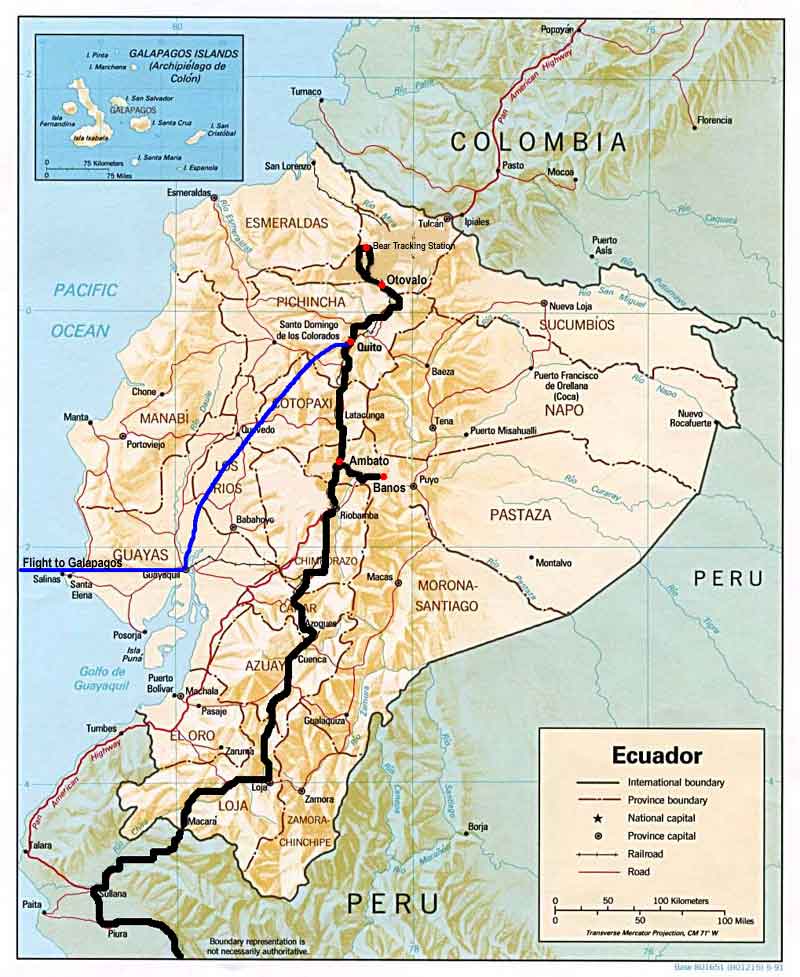
Friday 29th May 2004 - Ecuador - Cuenca; Dual Sports Moto Club; Back in Ireland! Volcanoes at Baños; On To Quito. Santa Rosa was not a place to linger and we were up early and away with a quick farewell to the dour faced staff at the grotty hotel. It was a grey dawn and the first part of today’s short ride took us through mile after mile of banana plantations. We were off back into the mountains to the city of Cuenca, billed as the prettiest in all Ecuador. It turned into another stunning road looping through red clayed jungle reminiscent of French Guyana. The road was in pretty poor condition in places with sections of mud and gravel for our delectation but the scenery and the knowledge that we only had 120 miles to do made it worth it. Grim faced locals looked on sternly as we rode along the Rio Jubones Valley and up into superb mountain scenery. We stopped in the town of Pasaje to confirm directions receiving monosyllable glum responses to our smiling requests for the right road. The Lonely Planet Guide warned that there was a big difference between the lowlanders and the highlanders in Ecuador, with the latter being more open and easy going. After about 40 miles of bad roads we ran onto good tarmac with road markings that wound us on to Cuenca, arriving in this fabulous city just before lunchtime. We rode through the cobbled streets to find the Tourist Information office, stopping at a museum to ask for directions. Lonely Planet was right, the highlanders were lovely people and the staff plied us with city maps, hotel lists and directions for the Tourist Information office in the Parque Calderon - the city’s main plaza. We arrived to find the office closed for lunch but the guy on duty opened up and soon sorted us out with a great apartment (the Otorongo) where we planned to spend the next few days. Apartments are a great find on the road as we can cook our own food making a change from living in cafes and restaurants (it had been over a month since our last hoe cooked food). We took a walk around the nearby food market relishing in the sights, sounds and smells of this lovely Latin American food fest. A street vendor had just spitted a fresh ‘Cuy’ (Guinea Pig) on the way in and it looked like a large skinned rat on a stick. By the time we were leaving it had had a good roast on the open barbeque and was ready to serve but to be honest, although both of us are fairly adventurous when it comes to food, we draw the line at eating pets! Later on we wondered if he had a last spin on the exercise wheel before getting the chop. We were sitting in our apartment after lunch, having spent a pleasant morning wandering the streets of Cuenca when the phone rang. It was reception saying that there was someone out front who wanted to talk about the bikes parked there. Eduardo and his wife Peggy had been driving past in their car when they spotted our 2 yellow BM’s out front. Eduardo has a 650 himself and so they stopped to talk about our trip and the bikes. They offered to take us out to see the sights around Cuenca, so next day we took a drive up into the mountains in Eduardo’s Jeep to visit the Parque National Cajas - an incredibly Irish looking place, wet and green with mossy covered rocks in an mountainous area containing some 250 small lakes. In fact in Ecuador the general landscape is incredibly like Northern Ireland, a small country with lots in it - mountains, coast and rivers. According to Lonely Planet, it is one of the most species rich countries on Earth with more than 20,000 plant species (as a comparison there are only 17,000 on the whole North American continent!). Bird life and mammals are also abundant in equally fantastic numbers, most famously perhaps in the Galapagos Islands. Over a spot of dinner with Eduardo & Peggy we chatted about life in Ecuador. Housing is cheap but there is also a lot of unemployment and imported goods are very expensive - our bikes are embarrassingly overpriced at US $20,000 a piece (they cost a mere ₤5,000 in the UK). After a relaxing weekend in this lovely city, it was time for the road once again with our planned route taking us North to another mountain town called Baños, famous for its proximity to the highly active Tungurahua Volcano and then on to the capital at Quito. It was not to be! On the morning of our departure, both bikes steadfastly refused to start. Eduardo had mentioned that there was a BMW agent in Cuenca so we rang him for their address. The agent turned out to have limited facilities, so Eduardo duly arrived from work along with his brother Pedro and 2 mechanics to help us. The bikes were eventually started using jump leads from a car. We learned a useful tip here for jump-starting the 650: access to the battery on the bike is difficult, being situated behind the headstock beneath all the tank fairings (these require the seat plus 16 bolts to be undone to remove them). It is also possible to damage the bikes computer / engine management system jumping direct off the battery, so what the mechanics did was to jump start the starter motor directly, connecting the positive lead to the starter motor terminal and then grounding the negative lead to the frame to turn the motor over (with the bikes ignition switched on). It took all morning to sort this out and we had to abandon our days travel plans and stay on another day at Cuenca. We felt very angry at the bikes - BMW have a reputation built on reliability and here we had two bikes in a very unreliable condition, forcing us now to abandon travel plans. Next morning - same again - utter refusal to start! Eduardo appeared with some guys from the Cuenca Dual Sports Motorcycle Club and we jumped them eventually off his car and were on the road for about 9:30am. We are now very wary about whether or not the bikes will start at all in the mornings. Baños should be better as it is at a much lower altitude at 1800m but Quito at 2850m is the second highest capital in the world after La Paz and so we expect to find starting problems there. It is strange as Eduardo’s 650 exhibits none of these problems and Francisco one of the guys in the bike club has a 650 Dakar model and again has no problems. In Quito there is a full BMW dealer so we plan to get the bikes sorted when we arrive there. We are now at a latitude of only 2 degrees south of the Equator, so you would imagine we are riding in tropical sunshine wearing only shades, shorts & t-shirts. The 200-mile ride to Baños felt like we’d been teleported back to Ireland with a looping, snaking road through filthy rain, drizzle, fog and low clouds that had us putting on extra thermal layers and digging into our panniers for wet-suits for the first time in 5 months travelling! We tried hard to imagine the gorgeous scenery that this road has to offer, but today it was all totally obscured by this most Irish weather. At times we crawled along at 20 mph, so dense was the cloud fog. Mags said afterwards that my rear light disappeared at anything over one bike lengths distance in front of her. At times the cloud fog would clear to reveal breathtaking vistas of green patchwork fields draped up the sides of volcanic monster mountains with the odd snow tipped peak showing itself in the distance. Around a bend and the whole lot would be consumed once more by the grey cloud fog. By 4pm we’d reached Riobamba, where at long last the dismal weather gave way to blue skies for the last hour of the ride. We rode on through wet muddy pot-holed roads around Ambato and then out onto an awesome twister that launched us towards the mighty Tungurahua Volcano that was smoking sinisterly up ahead of us in the evening sky. In the river valley below lay Baños, our destination and a warm meal and a bed in the lovely Hostal Plantas y Blanco. The bikes were garaged in the hostel’s beer store. We spent a pleasant day in Baños, where we walked up into the hills behind the town to try and get a better look at Tungurahua. The weather turned nasty forcing us into a wet retreat but we did see some good views of the town from the high elevations. The town lives very much in the shadow of the volcano and was totally evacuated for 3 months at the end of 1999 when seismologists predicted it was going to blow. Fortunately it didn’t, but it still could and as we walked in the rain we could hear its thunderous rumbling far off in the clouds. Trips were on offer to visit the beast at night, when the glow from the orange lava flows illuminate the sky, but the weather was too dismal to see anything so we had to forgo this pleasure. The bikes started, albeit reluctantly next morning and we set off to Quito. The road was another volcano wonderland - Ecuador is one of the most volcanically active areas on Earth and today we saw no less than 7 of them from the Pan-American Highway. We reached the outskirts of Quito around noon and pulled over to swap the road map for a street map in the tank bag. Just then a Mazda pick-up sporting Aussie plates pulled up and a big friendly grinning blonde haired giant stuck his head out the cab window and asked where we were from. When we told him Belfast, he replied, "Sure wasn’t I born in Carrickfergus meself!" Next up we were following him to his hostel near the airport - accommodation swiftly arranged! Chris Halliday is a smashing bloke and was to be the silver lining in our Ecuadorian clouds. He was born in Northern Ireland and moved to Australia when he was 2 years old. He has ridden bikes for BMW in Oz, is a keen sea-kayaker and took his Mazda pick-up truck half way round the world. He now resides in Ecuador where he runs the homely Andes Range Hostel, offering a little haven for us for the next few weeks. That afternoon he ran us round to Alvarez Barba, the BMW dealer in Ecuador where we arranged to have the bikes looked at the following week. We have a busy time ahead in Quito. It will be our last stop in South America and we need to arrange shipment of the bikes to Panama. We also want to see if it is affordable to visit the Galapagos Islands, as everyone we’ve spoken to who has been there claim it is one of the real pearls of any South American trip! Friday 11th June 2004 – Ecuador – The Middle of the World; Boobies and ‘Ah Fek’ Lava in the Fabulous Galapagos Islands! We liked Quito! We had a home of our own for the duration courtesy of big Chris and a full schedule to mark the end of our days in South America. The equator lies a few kilometres north of Quito and is marked by 2 visitor / tourist sites at ‘Mitad Del Mundo’. First, there is a big concrete tower in the main ‘theme’ park with a globe on top and a red line marking the equator running through it. The whole lot is surrounded by tourist stalls & fast food joints and is a fairly unremarkable place were it not for the Sunday afternoon local bands in the park, strumming out some great music. We heard Andean folk music as well as more contemporary stuff, all in all making for a lovely lazy afternoon. Actually the park and the monument do not lie on the Equator, being a minute or so south of it. But in the days before GPS, someone decided that’s were it was and so the monument was duly built & today it is still boasted as the ‘middle of the world’. Ecuador has some great stories like this. In Guayaquil, the biggest city in the country, it was decided in the past to erect a statue to Ecuador’s greatest poet, a chap called Jose Olmedo. However when they realised how much it would cost to commission a new bronze they chickened out and instead bought a second-hand statue of Lord Byron and erected it in the plaza with Olmedo’s name on it! The real equatorial line, as confirmed by GPS, lies in the second attraction at ‘Mitad Del Mundo’, a small Indian folkpark called ‘Inti-Nan’ that lies behind the ‘theme’ park. Inti-Nan was at first not much to look at - a few ancient dwellings and the odd home made statue in a pleasant garden surrounding. But the guided tour was terrific and a horde of scientific experiments had been laid on to demonstrate our presence on the equator. If you are a fatty and want to lose weight, get here quick as you will instantly weigh 1 kilogram less due to the lower effect of gravity here on the equator! We were also given the opportunity to balance an egg on a nail - again it is easier here due to the gravitational effect. The most famous equatorial effect is the plughole whirlpool and a demonstration was again laid on with a movable washbasin and some small leaves. North of the equator the water drains with an anti-clockwise whirl and a few feet away to the south this changes to clockwise. On the equator it falls straight through. The rest of the visit was fascinating as we learned how to shrink heads (a past practice of the Ecuadorian Amazonian Indians), had a go shooting darts with an Indian blowpipe (Mags ‘killed’ a cactus leaf) and saw a Guinea Pig farm. It was a great interactive day out and a memorable visit to the equator. Next week we sorted out our trip to the Galapagos Islands. There was a minefield of choices available and it took a few days to sort out what was a bargain and what was not. This next bit is included as a guide to help you chose a trip to the Galapagos, so if you are not really interested in this skip on to the next paragraph! The main options are 5 day and 8 day cruises, but bear in mind that the first & last days are spent travelling to & from the islands so really you have only 3 or 6 full days. With the 8 day cruises too, some are actually 2 x 5 day trips so you have a day dropping off & picking up passengers which can lead to time wasted on this transfer day in the middle of the trip. Also the group changes and so can the guide, which can also add disruption. There are a number of itineraries available and some of the cheaper options only visit the near islands in the group. Finally there is a choice in which class of boat you sail in ranging from Economic (rather basic tubs that all the guide books recommend avoiding), Tourist (better), Tourist Superior (now you’re talking), Luxury (great if you can afford it) and First Class (toffs only!). Some of these latter two classes are mini-liners with up to 100 passengers organised in different groups. One drawback of this type of vessel is the transfer times it takes to get everyone ashore (landings are by inflatable, outboard motored Pangas). Finally, you need to check on the guide rating as there are Class II and Class III guides, the latter being proper naturalists with biology degrees or equivalent, but sadly mainly being found on Luxury class only and above. We ended up with a great last-minute bargain, leaving on a Friday to cruise for a full 8-days on the Beluga, a fast 100-foot Tourist Superior (with aspirations to be Luxury class one day soon) class motor launch in the company of 14 others with a Class III guide. Booking it locally and still just off-season meant a 20% reduction on the normal fare. Accommodation was in excellent twin berth en-suite cabins and the price included all meals. We debated long and hard on whether to go ahead with the trip, as it would put a big hole in our remaining travel money but in the end we decided that as we were already in Ecuador, we couldn’t pass on the opportunity. Galapagos turned out to be a vast tableau of wildlife and the tapestry of animal encounters woven over the 8 days will stand as a highlight in our lives. The ‘Beluga’ did most of the sailing at night so we always woke up each morning with a new island on the horizon. Days were arranged with morning and afternoon walks with Juan our guide and opportunities for snorkelling the spectacular reefs off the islands in between. Intermingled with the wildlife encounters were the culinary delights from the ships cook who provided wholesome and tasty breakfasts, lunches and evening meals. The pace was so easy and the company so good that we all settled into having a great week at the islands. But the stars of the whole week were the wildlife. For centuries they had no encounter with mankind and so do not possess any fear or shyness when humans approach them. Leave your zoom lens at home – want a photograph? Just go right up and tell the beast which way you’d like him to pose! Our first landing on North Seymour Island had us stepping over lazy sealions to visit a Booby colony. Boobies are comedy seabirds of the first class (their name alone deserves a hearty fnarr-fnarr!) and in the Galapagos, come in 3 varieties - Red-Footed, Blue-Footed and Nazca. They serve as an excellent example as to how the wildlife here has adapted to exploit and share the terrain on the islands. The Red chaps nest in trees and would be more difficult to spot. The Nazca (who have no special coloured footwear) nest on the cliff sides whilst the Blues, our favourites, nest on the ground. These latter were everywhere on North Seymour. All of the Boobies have stunning piercing eyes, set on the front of the head to sight directly forwards along a long sharp beak. They possess an ungainly waddle on the ground having to lift each huge paddled foot like a cumbersome frogman in his flippers on land. They struggle too to take to the air, lurching and lumbering along over ground plants and rocks to gather up air speed, but once airborne they are masters of the sky. Watching them hunt is a special experience. They soar & glide, circling shoals of fish with those forward set eyes in scan mode, searching the oceans for prey. Once sighted, their slender gull-wings fold in to the sides of their slender bodies transforming the bird into a streamlined projectile. With the eyes maintaining missile-lock on their target, they plummet from the sky with incredible velocity and deadly accuracy to harpoon the unsuspecting fish below. A duff landing returns the Boobies to earth and once back on the ground the grace they had in the air disappears and they resume their great comedy roles as they waddle back to the nest to feed their huge fluffy white chicks. Most spectacular of their ground behaviour are the mating displays of the solitary males to attract mates. They have these striking blue feet that they love to show off, so a stance is adapted with the gull wings folded at 45º and tilted forwards so the bird looks like a huge ‘W’ from the front. They then rock from side to side, sticking one foot out at a time so prospective partners can see their lovely blueness, like a great Hokey-Cokey dance, all the while braying to make a god-awful din! North Seymour also had colonies of the Pterodactyl like Frigate Birds, with the males displaying their magnificent red chest balloons in an effort to attract mates. Their hunting technique is incredible. Not being true seabirds (their feathers lack the oily coating to make them sea-resistant & waterproof), they look for other sea hunters like boobies returning from a successful hunt and then they make an aerial interception to try to steal the catch! The little Brown Nodi Birds are another pirate scavenger of the Galapagos. These small seabirds follow Brown Pelicans as they hunt for fish. The Pelicans also make a diving attack but once they resurface, they are ungainly in the water and need a minute or two to sort their flight feathers and reset wings for take-off. During this time the Nodi bird lands on the Pelican’s head ready to grab the fish from out of the Pelican’s beak in the confusion! We saw them do this near the boat on numerous occasions and it was incredible to see how daring these little thieves can be. The islands themselves are nothing spectacular - a series of low volcanic cones that have erupted from the seabed to form the island group. Some of the landscapes we were walking on are fairly new – like Isabella Island, with fresh lava fields less than 200 years old. The lava fields have 2 main characteristics. First there is ropey or spaghetti lava, known by the Hawaiian name of ‘Pahoehoe’ lava, slow moving lava that has oozed out of the earth, looking like it has been squeezed out of a big tube and allowed to set. This type is quite smooth and easy to walk on. The second type is known as ‘Aa’ lava, another Hawaiian term, and this stuff was from a more violent eruption, full of gas when it flowed with corresponding pockets or bubbles when it set. As a consequence, it tends to be full of very sharp edges and is lethal to walk on. Pahoehoe means lava you can walk on barefoot. Aa means lava you cannot walk on barefoot. We christened it ‘Ah-Fek’ lava, from the profanity to be uttered when you realise that you have to walk across another large patch of it! The other main attractions on the land were the Iguana colonies and of course, the Giant Galapagos Tortoises. There are two types of Iguana – Land and Marine. The former are yellowish brown in colour (depending on which island you are on) and they exist on a diet of cactus pads. Again they are not shy of humans and you can get right up close to watch the little dinosaurs in action. Males have spiky, punk rocker crests and are incredibly photogenic. The Marine Iguanas are all black and on Fernandina Island we watched as they returned in droves back onto land after grazing on seaweed for lunch. They emerged from the sea onto the rocks like some slow-motion alien special-ops commandos in their black wetsuits. They clambered away from the sea onto the black lava rocks to bask in the sun, digesting their dinner. Another day took us to a Giant Tortoise reserve. These monster beasts had to be approached silently as of all the animals on the islands they are most shy and withdraw into their shells at the slightest sound or disturbance. Juan reckoned that they could live up to 200 years of age, meaning that some of the ones we saw in our visit could have been around when Charles Darwin originally visited the islands. There are unique species of tortoise, endemic to each island and at the Charles Darwin Research Centre near Puerto Ayora they have the sole remaining survivor from one of the lesser islands – a huge old male called ‘Lonesome George’. There is a $20,000 reward for a female of the sub-species (it is believed that there could be one somewhere in the world, taken from the island many years ago as a pet by visiting sailors) but in the meantime he has spent the last 9 years cooped up with 2 females from another island in an attempt to at least preserve part of his gene pool. In this time he has shown absolutely no interest in mating with either of them. We all speculated on the various reasons for this - he could be gay or the females could be lesbians. It was also suggested that we leave some ‘tortoise porn’ around his enclosure – you know, David Attenborough books, BBC Wildlife magazines etc, to get him going! The final ‘element’ of our Galapagos visit was the sea, especially the snorkelling trips beneath the waves around the various anchorages and islands along the way. You don’t need to be a good swimmer or an expert snorkeller to do this. Some people just stuck a life jacket on with the snorkel gear and off they went, easy peasy! Just sticking your head beneath the surface revealed an eye-dazzling tropical fish paradise, with every colour in the rainbow represented in brilliant luminance throughout the rocky reefs. Crazy starfish in bright yellows and reds carpeted the floor and off the reefs, huge shoals of shiny silver fish shone and flashed in the watery sunlight from above. The clumsy sealions that we met on land on each of the islands joined us in the sea, assuming a newfound grace in their natural element. They were curious to our intrusion and swam up close to have a look, spinning and pirouetting as they circled our snorkel masks. In one bay Mags danced a ballet duet with a graceful young sealion. She had come up for air and was treading water when she turned round to see this sealion doing the same. They looked at each other and both ducked under to begin the dance. The Sealion swam around her and began doing twists & turns. Mags did the same, copying as best she could. He recognised the game and joined in performing more and more complex rotations as she struggled to keep up for the next few minutes. The big grinning smile on her face when we returned to the boat was priceless! Other compatriots in the sea included Giant Sea Turtles who mooched around grazing on sea plants, oblivious to our presence as we swam alongside them while they fed. Another was the Galapagos Flightless Cormorant. These birds have lived for so long in the absence of any natural predator on the islands that they have lost the power of flight and feed by swimming off the rocks and fishing. Again they were entirely oblivious to our presence, getting on with their hunting as they searched out rocky nooks and crannies fishing for food for their chicks. The most fantastic marine encounter happened on the third day of the trip, just off a sunken volcano crater known as the Devil’s Crown. We were having breakfast when dolphins were spotted out to sea. An advantage of travelling in a smaller party (rather than on a huge cruise liner) is that you can change the itinerary at the drop of a hat. This was swiftly demonstrated when we asked Juan if we cold go see the dolphins. In 5 minutes we were loaded into our 2 Pangas (the inflatable motor boats with powerful outboards used for ferrying to and from the islands) with swimwear and snorkel stuff and we were off. It soon became apparent that this wasn’t just a couple of dolphins we were looking at. The sea looked at one point like it was raining dolphins, there were just so many around us. Juan later estimated it to be a pod of between 500 and 700 Bottle-Nosed Dolphins, a rare occurrence that he has only seen once or twice before in his 16 years as a guide here! Soon they were all round the boats as we sped along, delighting in swimming ahead and then off to perform show-off leaps from the sea and playing around doing headstands and tail slaps. Next thing, the boats were stopped and we were over the side, snorkelling in the middle of the pod. The air of rushed excitement to get to the boats and out to the dolphins disappeared once we entered the sea. All sound disappeared, the peaceful silence slowly filling with dolphin clicks and whirrs. Like the sealions they were curious at these strange intruders to their domain and circled round to get a good look at us. Of course this meant we had a good look back. From the surface, we were only seeing the upper layer of the pod. Once we were in the sea, looking down it appeared that the ocean was actually made from strata of dolphins – they were everywhere. My lasting memory of this encounter is swimming ahead with 3 dolphins coming straight at me, with their lovely, smiley faces. As we neared collision, one broke left, the other right and the third went straight under me, leaving me twisting and spinning trying to watch them as they disappeared in different directions! So that was Galapagos. It was another highlight to our Pan-American Adventure, one that at times left us speechless and breathless at the wonders of this Earth. If you ever wanted a really fantastic holiday, to celebrate a special birthday or anniversary then this is it. Ecuador is such an easy place to travel around and the Galapagos Islands are a dream holiday where every day is filled with priceless memories. The pace is so easy going and the company so good and an 8 day cruise here could be complemented with a trip to one of Ecuador’s Amazonian jungle trips, where you will see more of the amazing wildlife that litters this fair land, to make it the holiday of a lifetime! |
|
|